≡ Menu

Your Escape Blueprint

Retirees find new purpose in Playa Uverito, Panama

Retirees find new purpose in Panama

If you have ever dreamed of escaping the 9 to 5 and following your dreams and then doubted that you could, remember others have already! Allow us to introduce you to more of our fellow “Escapee’s”.

Their answers may inspire you too to follow your dream.

Why move overseas?

In 2007 Loni (now 62) and Mike O’Grady (66) were lucky to survive the rock fall and 64 ton boulder that crushed their car in a major slide on the Big Island of Hawaii. Loni woke four days later to find that she had already undergone two surgeries to repair the injuries sustained as their car was hit, flipped and then hit by a following car. During the next 18 months, she had eight surgeries and slowly progressed from a wheelchair, to crutches and to a cane.

Mike was released from hospital after one week with five broken ribs, a broken collarbone, sternum, and wrist, one year later he had knee surgery and two years after he had to have both knees replaced.

Although the site “was graded # 38 in severity out of 200 potential rockslide sites on the Big Island in 2005 by a company hired to complete a rock fall hazard index, ranking severity of potential rock fall sites for remediation.  The chief highway maintenance engineer for the island, was unaware or the study findings, and the fact that he was supposed to begin remediation of those sites”.

They had lived and worked on the Big Island as a speech-language pathologist and school social worker for years. They loved the warm climate and during their free time, they worked at the local Parrot sanctuary and looked after their own gold macaw and two cockatoos.

Following the accident, ‘with both of them denied compensation from the state run program; Mike had to return–still recovering from his injuries–to a modified desk job to earn an income”.

The harsh reality of having to survive on one income as Loni was unable to return to work plus ongoing medical expenses was a huge financial drain. Retirement seemed to be further away than ever.

As anyone who has visited Hawaii knows, it costs a lot to live there, which meant they were struggling to maintain their lifestyle there. There was also no way they could retire there or fulfill their dream of living Oceanside. They started looking for alternatives and spent countless hours researching via internet, forums and emailing expats in the area.

What were they looking for?

They had a very clear idea of what they wanted. “We were looking for a country that was stable politically, was safe, was tropical or subtropical, and was much less expensive, with the possibility that we could live oceanfront”. They settled on Panama.

photo-6

Photo Credit: Mike O’Grady

When and how did they move?

In November 2012, after selling or giving away their belongings, including their beloved birds, they flew to Panama. The popularity of Boquete as a retirement destination had peaked their interest and was first on their itinerary. After only two weeks, they realized this was not the place; neither was the lifestyle of nearby Bocas Del Toro even though living oceanfront was possible.

On December 15th 2012 they arrived in Playa Uverito on the Azuero Peninsula. They “fell in love with the place and the locals who showed us what Bienvenido (Welcome) really meant”.

It took them a few weeks to find a permanent place to call home here. Thanks to a Panamanian veterinarian, their new home is a one story glowing yellow cottage perched just feet away from Playa Uverito’s beach. The wide shady veranda fanned by the steady ocean breeze is dotted with hammocks, wicker rocking chairs, dogs, dog toys and beds. Papaya, Bananas and limes grow in their yard, as do a number of wire enclosures for housing the abandoned and starving beach dogs they rescue.

From her wicker rocker, surrounded by her dogs, with a rescued puppy in her lap, Loni explains the dilemma that they faced. They loved living in Hawaii, their work and the work they did with the Parrot sanctuary, which was a big part of their lives there. However, they knew that there were other places “which would allow them to not only recover their pre-accident lifestyle, but to achieve an even better lifestyle”.

The biggest challenges for them?

Was making the decision to leave, because they had only a limited moving budget they had to give up their two cockatoos and their blue and gold macaw to make the move. They also miss family and friends but still manage to go home regularly.

Loni continues, “I have worked hard on a daily basis to heal myself after the medical experts had finally told me that “this was all they could do”.  I have slowly improved to my current level of functioning.  Quite frankly, I am more content now, after this close brush with death, than I ever have been”.

How does their new life compare with what they left behind?

Within days of arriving, they noticed the large number of dogs suffering from starvation and disease, roaming the beach and town in search of food scraps. They quickly saw that their love, compassion and caring were needed here too, this time for furred rather than feathered friends.

They started by bringing a little food to the beach each day, identifying and befriending the dogs who appeared in the most need. The numbers of starving, diseased and abandoned dogs kept expanding. Soon they were feeding and housing nine of them and looking for ways to help the rest.

Using their own funds, donations from local businesses and with help from Boquete’s Los Amigos des Animales and Animal Avocates of Pedasi, they are now able to provide food, shelter and love for twenty dogs.  With the help of these associations and Spay Panama,each dog is spayed or neutered and nursed back to health and eventually placed in a forever home.

They may be retired but they are busier than ever. On my first visit they were overseeing construction of a new enclosure, cleaning poop out of the pens, cooking chicken livers (to supplement the dogs diet) and handing out ear scratches and belly rubs as they went. They also walk the beach every day, checking on the health of the other beach dogs and on the lookout for new arrivals. Sadly, they have seen dogs thrown from cars or simply left behind to fend as best they can.

Within one short year, they have upgraded to oceanfront living, are healthier and happier than they have ever been and live comfortably on their retirement income. They have been warmly welcomed into their community and have discovered a sense of purpose in establishing their shelter Adopt a Dog Azuero. Visitors are always welcome and donations of food, collars, leads and cash are all gratefully accepted.

Loni and Mike’s advice to others is simple. “Decide what is important in your life.  Make a checklist and do the footwork via research.  Email expats in that area and ask questions.  Screw up your courage and just do it!”

Loni also adds, “I am not the person that I was prior to the 2007 accident, I am changed/different.  I am grateful for all I was given in life, everything that was taken away, and for what I still have.  We are lucky people.  Today I try to see “the silver lining” of whatever problem that confronts us.  I am alive.  I am content.  I am grateful”.

To find out more about their new purpose in life or to donate (donations are very welcome, dog food is not a cheap item in Panama) please visit Adopt a Dog Azuero and use the PayPal button.

P1210438


There are more Escapee profiles to come. We look forward to hearing your feedback, comments or ideas for further profiles.

Hasta leugo.


7 comments

Shoddy Construction makes Cranky Gringos

Are you one of the many retires thinking about buying a property in Panama? If so you need to do your homework and thorough homework before you buy, otherwise your dream retirement may turn into a nightmare.

Over the past several years, Panama has experienced a construction boom. New construction companies have been popping up like mushrooms. Like anywhere else in the world, when the talent pool gets stretched, costs go up and quality goes down.

We have met many owners with nightmare stories about what should have been their dream home. We have heard tales of development projects that involve shoddy construction, empty promises, and possibly outright fraud.

The problem with poor construction and shady developers has become a recognized issue in Panama. Between May 2006 and June 2013 there have been 3,277 complaints against real estate developers, complaints run the gamut from breach of contract, unfilled warranty claims and failure to return deposits.

The July 2013 forum with the Panamanian Institute of Consumer and User Rights (Ipadecu) resulted in the decision that The National Union of Consumers and Users keep a registry of complaints against developers and operators of real estate projects. Note at the time of writing the author could not find links to the registry or to any qualified property inspectors in Panama.


Panama Construction-2 Panama Construction  

We rented a beach community condominium a few hours from Panama City. Within a few weeks, we discovered why such a registry is needed.

Speaking with both owners and property managers the following Issues about the complex were revealed:

  1. Plastic water lines installed without being glued resulting in leaking joints behind concrete walls.
  2. Leaking gas lines.
  3. The original sloping roof design was changed to a flat roof which contributes to the top three floors experiencing water ingress
  4. The well water in some of the buildings is potable and in others, the water has high bacteria counts.
  5. In some units, the floor tiles lifted due to incorrect materials usage. 
  6. The sewage treatment plant is apparently faulty; resulting in sewage leaking into the nearby river, this of course empties into the sea and onto the beach area, (at low tide the river does smell bad).
  7. The water feature on some of the buildings does not function resulting in standing water and clouds of mosquitos (not good during a dengue epidemic)

Although the unit we were in did not experience any specific issues (with the exception of the elevator not working for several days). The evidence of poor construction is apparent in the indoor cracks and water stained exterior.

Troubling are the unsubstantiated rumors of beach sand used in the buildings concrete. This is a real concern; beach sand is contaminated with chlorides (salt) which causes embedded steel reinforcement to corrode almost immediately. Corrosion causes the steel to expand, resulting in the concretes failure. As the concrete cracks, the rebar is exposed to increased concentrations of water and oxygen resulting in more corrosion. A building constructed from beach sand is doomed from the day it is built and will rot from the inside out.

Building issues aside, the result of the ongoing battle between owners and the developer has been nasty. Some owners frustrated by the unaddressed problems have refused to pay maintenance fees and in turn the developer, at times, restricted access of gas service providers and elevator repair technicians. Security has also reportedly restricted resort access for the owners. 

Panama can be a wonderful place to live and invest, however it is critical to perform your due diligence. Assuming that a building is built to North American Standards is a huge mistake.

 When it comes to living and especially investing in a foreign country, we recommend you give it a thorough test drive before plunking down your hard-earned dollars.

 Here are a few tips to help you avoid your dreams turning into a nightmare.

 1.    You have heard it a million times. Rent for at least 6 months before even considering moving there.

2.    I would also strongly recommend renting the specific property you may be interested in purchasing before you purchase the property.

3.    Do your own research, especially if you are interested in an older development. A simple google search may bring up some surprising comments.

4.    Take the time to thoroughly explore the building and its surroundings and make sure you speak to current residents.

5.    The sales department and your realtor may be very helpful sincere people, however remember that they want you to buy from them and some of them can be very skilled in avoiding or skimming over important questions.

6.    Make sure that you have the purchase contracts translated into English and that they match the Spanish one.

7.    Are there any guarantees built into the contract with regard to the developments future expansion? Your beautiful sea view may be obliterated by a mammoth resort in a few years’ time.

8.       Do all the diligence you would do when purchasing a property at home, remind yourself it is a different country with different standards and then do twice as much research.

index_clip_image010 index_clip_image012 index_clip_image014
Post Script (January 26 2013)
Yesterday as I was sitting in our rented 5 th floor beach apartment when I hear a thunderous bang. Upon  inspection the source of the crash was evident. A 30 pound chunk of concrete (approximately 12 x 10 x 3 inches) fell 140 feet from the top of the building to the pavement below. The piece of building landed approximately 6 feet from the front entrance. Luckily nobody was hurt!!!  Not only does shoddy construction make for cranky gringos – it may also result in dead ones!
0 comments

Panama’s Big Hairy Wart

Panama can be described, as a beautiful princess. A princess who although stunningly beautiful, vibrant and bursting with energy, has one obvious disfigurement, she has a large hairy wart! Even though it dominates the tip of her dainty button nose, she seems oblivious.

If I were forced to describe Panama in one word  – that word would have to be “Trashy”.

As visitors to Panama, your first impression will probably be the one we experienced. There is trash everywhere! Trash in the ditches, in the streets, plastic bags in trees, and trash piled in front of homes.  At the feet of Panama City’s impressive skyline is an amazing mess of clotted traffic and stinking, unhygienic piles of garbage. The waterways that run through the city into the Bay of Panama, straddle the line between river and open sewer. The assailing stench of the brown garbage slush that passes for water grabs you by the gut and twists violently.

 Panama City-15

Panama has a problem, a trash problem. A problem shared by much of the developing world. Unlike most of the developing world, Panama has a booming economy, which leads us to ask why can this not be handled. Is our princess really so oblivious to her big hairy wart?

Panama’s ability to generate garbage far outstrips its ability to deal with it, or at least the funds allocated to facilitate its proper disposal.

As observers bought up with a no littering mentality, we cannot fail to note that there appears to be a cultural aspect to the trashiness of Panama. Many Panamanians are very casual when it comes to garbage. We have witnessed this on a daily basis, people simply toss garbage over their shoulder once done with. The thousands of plastic plates, forks and styrofoam containers used by the cities food vendors are tossed away once done with, either onto the street or out their car window–apparently, without any thought at all–it appears that garbage is somebody else’s responsibility.

The piles of gaping bags which line the streets and the junk littering the beaches not only offends the tourists but also has festered into a public health issue. When we visited Panama 6 months ago, the stories on the evening news were the same as they are today – the piles of stinking trash are breeding grounds for mosquitoes and rats, causing a real concern for public health.

Panama City-3

Mosquitoes can breed in small amounts of water, even those found in a beer can, a stryofoam container or an old tire. Dengue fever is a problem in Central America, especially in Panama. There were 3,232 cases reported in Panama in 2013, three times the amount reported in 2012. The nationwide Dengue alert is now at epidemic status.

Even when the garbage is collected – the health issues are still present. Panama’s garbage landfills often catch fire, blanketing its downwind citizens in a cloud of toxic smoke. The majority of dumps in Panama are located in shrubby areas, swamps and riverbanks. Residents in Playa Uverito near Las Tablas speak of seeing overflowing dumps bulldozed into the mangroves. This garbage often ends up on the beaches after heavy rainfalls. 

Panama Trash-3

Another concern with many garbage dumps in Panama is the lack of proper environmental engineering practices. Protective membranes with layers of earth covering the garbage are often nonexistent. This is a real concern when you consider that some of the municipal water supply comes from nearby wells.

Mahatma Gandhi said, “The greatness of a nation can be judged by the way its animals are treated”. The same may be said about what a nation does with its garbage.

Things do change with time. I remember not too long ago in North American smoking was good for you and drinking and driving was considered a sport!

Awareness appears to be growing; is there change afoot in Panama? Concepts such as recycling, sustainability and environmental awareness are appearing more in the media. Beach clean ups are common occurrences especially in the Beaches area outside of Panama City. Yet some beach goers still consider it too much effort to take their trash home with them or to walk a few feet and toss it into the nearby trashcan (if it is not already overflowing). Instead, it litters the beach or washes out with the tide, laying broken bottle and rusty can traps for the unwary wader and floating plastic hazards for marine life.

Maybe the Dengue hazard will be the incentive for the princess to spend a little money, a little effort and get that big hairy wart removed. Hopefully Panama will soon no longer be a country of plastic bag trees and garbage choked gutters.

Panama Trash-10
10 comments

Dancing in Panama

What better way to celebrate Christmas than with the cutest bunch of kids this side of Rio Hato, Panama.

Our early Christmas outing was a fundraiser for the Panamanian dance troop Orgullo Rio Hato Sur the Pride of South Rio Hato. Entertainment was the dancers themselves of course and although they come from one of the poorest communities in the area, they know how to have fun.

Ranging in age from 5 to 13 the girls were dressed in the Pollera, a traditional costume of wide flared skirts and lacy blouses. Their hair pinned up with a smaller version of the intricate handmade, bead and wire headdress known as Tembleque’s. The boys could not compete with such finery, at least not until the second session where the carnival style dress of multi fabric scraps haphazardly combined in riotous colors made them as colorful as the girls.

The group has been doing performances in the area for a few years now. They are encouraged and supported by the owners of the XS Hotel & Bar who also arranged a surprise visit from Santa complete with gifts for all.

It was a fun night. It would be hard to say who had more fun the kids or the completely captivated folks watching the show. It looked to us that the girls had the most fun, especially when they got the chance to “walk all over” the boys. You have to see it for yourself, we hope you enjoy it as much as we did.

P1210604
0 comments

Christmas Panama style!

Spending December in Panama with its Spanish and American blend gives a chance to experience some alternative traditions to the usual North American Christmas fare. December is a busy month here, starting with Mother’s Day on December 8, this is a big event as sons and daughters travel miles to be home to celebrate. Mothers, grandmothers, aunts and godmothers are honored with presents, traditional dishes and a day off from the household chores.

Panama City holds (December 15th)  a huge parade with school bands and floats, live artists and of course, all of Panamas favorite foods served along the 3km route. Many Panamanians begin decorating on the 16th and continue adding all the way to the 24th. Villages and towns transform gradually as the trees, lights and figures emerge day by day, much more intriguing than the all out at once tradition in much of the world.

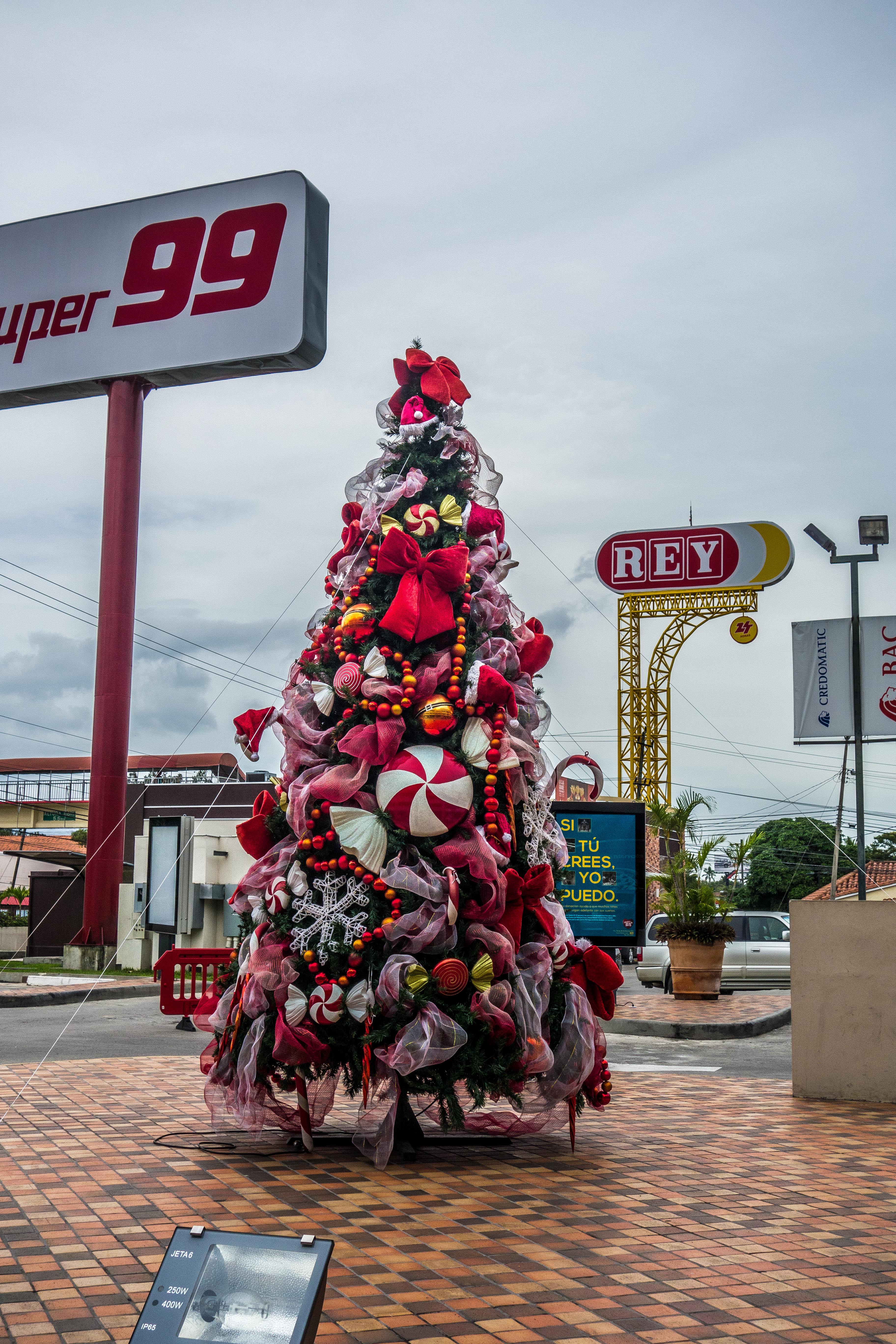
Nacimientos or Nativities scenes are set up in many homes and Christmas trees are very popular–typically decorated with huge bows, flowers and lots of tinsel. Some of them have travelled from our home state, although they smelled of BC they were shedding fast in the heat—by Christmas Day they will be highly decorated skeletons.

Christmas in Panama

Smaller neighborhoods hold the Spanish Las Posada on the nine days before Christmas. A successful posada needs the involvement of the whole community. Each family builds a makeshift shelter from palm fronds on their property. Two of the community’s children are dressed as Mary and Joseph and every night they mimic the search for a place in the inn. Each night they parade from house to house, where they are turned away with cries of “no room at the inn”. At the final house where they and their entourage finally enter, they sing, hit piñatas and enjoy traditional dishes. On Christmas Eve the final night, they visit all of the homes in village.

Christmas Eve is the highlight for Panamanians, instead of Christmas Carolers and ringing bells they shoot off fabulous fireworks. The huge popularity of fireworks is evident in the days up to Christmas. Anytime is a good time to celebrate here, expect to see them nightly in the run up to Christmas.

Instead of tucking the kids early into bed, while Mom & Dad have a quiet night before the onslaught of Christmas Day. Panamanians celebrate and dance in the streets. At the stroke of midnight—indicated by the sight and sound of hundreds of fireworks—they sit down to a feast of Chicken tamales, Arroz con Pollo chicken and rice, pavo turkey and relleno stuffing. Bowls of fruit and fruitcake are the traditional desserts washed down with spiked eggnog called Ron Ponche.

After dinner, there are late night visits to relatives and phone calls to those far away. Only after all this are the little ones tucked into bed and their presents placed ready for sleepy eyes on the 25th. They spend Christmas Day visiting Church in the morning, then family, friends, and eat more of the traditional foods–another day of singing eating and drinking–just like home!


Panama Ron Ponche Recipe:

2 cans of condensed milk
3 cans of evaporated milk
6 eggs
1/2 bottle of Rum
nutmeg to taste
Combine the milks in a large container;
beat the eggs in a separate bowl
stir them into the milk mixture,
Slowly add the rum.
Add nutmeg to taste.
Note: Refrigerate until ready to drink.

0 comments

What do Iguanas, Boas, Frigates and Crabs have in common?

Isla Iguana has the best and whitest beaches on the Azuero Peninsula,  Panama. Today the island is home to large populations of crabs, black and green iguanas, boa constrictors and red-throated frigate birds. All of these were in evidence when we decided to explore this beautiful spot.

Getting there is easy from Pedasi town, drive or catch a cab to Playa Arenal, where you will find a number of boats and their Capitan’s willing to take you over and back for $70. Most guidebooks recommend you arrange a pick up time and only pay when they have delivered you back safely at Arenal. Our Capitan was Lionel and for $70 he took us over, provided us with snorkeling gear and settled down with his fellows in the shade to wait until we were ready to return.

El Cirial is the largest beach and where you land, it boasts the ranger’s station, a small reef education center and a large covered seating or picnic area. Although there where bathrooms at the time we visited, they were either nonfunctional or padlocked. There were also iguanas on every nearby rock and tree.

Isla Iguana-5

Isla Iguana is also home to El Faro a smaller beach with stronger currents and better snorkeling. A hiking trail connects the two but be prepared to get wet and muddy feet if arriving in or after the wet season. Within only a few minutes of setting out on this trail, we witnessed two of the islands inhabitants in a life and death struggle. Alerted by frantic thrashing we turned to see a boa constrictor wrapping itself more securely around a 2.5-foot long iguana’s head and shoulders. Stunned, dazed or stupefied the Iguana met its end in the boa’s deadly constricting embrace.

In shocked silence, we skirted around the grisly tableau and returned to the beach, our picnic and the iguana’s favorite pastime—taking food from the tourists. This can be irritating, entertaining or a little wild. We experienced the attack (Monty Python rabbit style) of the killer iguana. Not content with the pieces of apple being tossed to his companions in front of me one large fellow decided to go for the source and launched himself from right field onto my right hand, I shrieked, dropped the apple, he dropped, pounced and ran off victorious. Note to self-do not feed the wild iguanas …….. they scratch.

The islands hermit crab population was out in great force too, we found thousands of them all heading inland just behind the rangers station. The scrabble of their passage over the rocks, pathway and scree was what alerted us too them. Hundreds of little shell houses were on the move–as was evidence of our love affair with plastic—plastic canister’s had also been occupied by these prolific soft bodied crabs.

The 58-hectare island has not always enjoyed the peace and quiet it enjoys today as a wildlife refuge. During World War II it was a US Air Force bombing range. Two unexploded 1,000 pounders were found and detonated on site in the 1990s, unexploded ordinance may still exist in the surrounding waters.

Despite exploding bombs and coral, bleaching it is worth snorkeling. These waters have less silt than the majority of coastline–making it easier to spot the large puffer fish, parrotfish and tangs.

Throughout our stay, we had watched clouds of frigates circle overhead, we had arrived during nesting season. Our Capitan was happy to take us around to the other side of the island for a closer look. The red throats of the males as they looked after baby spotted the shorelines greenery like low hanging berries.

The island is also home to nesting turtles April to September and humpback whales abound from June to late October early November, one more reason to return to this little piece of Paradise.

Note: Make sure you have your passport or a copy of your passport and entry stamp with you as you have to check in with a customs official before you leave Arenal. You also have to pay $10 as a tourist or $4 as a resident to the rangers on the island. Be sure to take your own food, water and lots of bug repellant, may we also request that you take only photos and leave only footprints.

Isla Iguana-2-2
0 comments

Impressions of Pedasi, Panama

Pedasi is both a district and a small town on the southeastern tip of the Azuero Peninsula in Los Santos province. It has seen increasing coverage as the up and coming retirement destination in Panama, with its “friendly locals, delightful architecture and beautiful beaches”.

We found that the town of Pedasi was not what we expected as the information gleaned from our prior research was on the district of Pedasi as a whole. The multiple seaside villas and condominiums advertised as being in Pedasi  are in the Pedasi district not the town itself. Pedasi town is not on the ocean and has no beaches of its own. There are indeed numerous beaches in the Pedasi district and all are at least a few kilometers out of town.

Pedasi Panama-2

It is a very tidy little town of Spanish Colonial architecture. Homes are gaily painted and residents greet all passing with Hola as they rock or swing on their covered porches. The central road (Avenida Central) and a small plaza surrounded by homes, businesses and the beautiful church is the focal point of the town.  Most of the town’s hotels, restaurants and stores are on the main drag, or close to the plaza.

Pedasi Panama-4

There is a fast growing expat community here and they are very proud of their home. Newcomers receive a warm welcome and everyone is willing to tell you how to get to their favorite beaches or their favorite restaurant.

Pedasi’s growing popularity is already causing a shortage of rental options in town—along with inflated prices. We had planned to stay for at least a month however, we did not find anything for which we were willing to pay the asking price. See Notes below:

Infrastructure

The town has a public health clinic, two banks, a library, and a handful of restaurants including wonderful Italian food at Pasta y Vino. There is also a Chinese, Pizza and local Fondas along with mini – supermarkets and small shops. Although there is not a produce market, there is a blue truck loaded with produce from Chiriquí every Thursday, and a grey one which operate as mobile markets.

Decent roads, cable and high-speed internet are also in place thanks to Panama’s first female President Mireya Moscoso. Native to Pedasi, she made it an objective during her term to improve her town of birth. A commemorative bust and plaque take pride of place in the main town square.

Pedasi Panama-3

The (hopefully) soon to be opened airport at nearby Rio Hato will provide an alternative to driving the 360 miles from Panama City.

Activities

These primarily revolve around the beach and the ocean. Nearby beaches, include Playa Venao (30 minutes away) famous for its consistent surf. Playa Toro or Bull Beach (2 kilometers) is an almost deserted stretch of dark sand beach. To get to the picturesque Los Destiladeros head towards Playa Venao turn left off the main road in Limon and keep going.

Playa El Arenal is close by and is the place to catch a boat for the trip to Isla Iguana, a national park and wildlife refuge.

Spend a day at Isla Iguana–this beautiful island has white sand beaches, hordes of iguanas and (when we visited) nesting frigate birds. This is the place to go snorkelling, although the coral has experienced bleaching in the past it still supports a variety of surprisingly large parrotfish, tangs etc. Whale watching is a popular pastime here from June to September.

Fishing is also a favourite here as is hanging out in the plaza and joining in the various festivities and festivals especially during February.

Beeronomics

  • A Balboa local beer in a restaurant is about $1 to $1.50
  • A cold Balboa from a supermarket 65 cents each.
  • Restaurant meals $5 to $15 and up
  • 1 kg Boneless chicken breasts $5
  • Dozen Eggs $1.75
  • 1 kg Tomatoes $3.00
  • 5 Bananas $0.50

Current Property Prices (November 2013)

Two bedroom townhouse close to Playa Arenal $209,000

Beachfront lot in Lagarto Beach $60,000

Two bedroom, one bath home renovated home in Pedasi town $80,000

Rentals (monthly)

Note: Some accommodation is very basic a filthy moldy house with a shared outdoor kitchen was one offering for the outrageous rent of $400. A small grotty apartment just outside of town for $570 was also easy to refuse.

Suitable accommodations can be found if you allow enough time. A great resource is Karla who runs the gelato shop and knows who has what to rent in the area. She is a delightful Australian lady and very willing to assist. Be prepared to spend more time and maybe more money than you would expect in your search here.

Two bedroomed unfurnished Panamanian style house in town $400

New small modern apartments on the main road are available for $550 to $750

Ocean lofts in Los Destiladeros $995

Two bedroom villa near Playa Venau $3,000

What’s to love?

Pedasi is a laid back, no rush comfortable place with a small village feel. The locals are friendly and helpful, although you will need at least basic Spanish.

Make sure you swing by the Gelato shop in the plaza for the best $1 ice creams ever, also home to the super friendly Karla.  Smiley’s Bar is a great place to meet the local expats, they have live music Tuesday and Friday evenings.

What’s not to love?

Water pressure varies, it can be common to have very low water pressure during the daytime, in town itself. According to one source water supply is a concern for the whole of the peninsula as it does get very dry and very hot.

As development continues and demand increases this could be an important issue. If planning to purchase here make sure you know where your water supply is coming from.

Our Perfect Abode Checklist Comparison

  •  A stable government and economy        √
  •  Affordable properties with foreseeable appreciation   ?
  •  Sunny and warm climate   √
  •  Friendly locals   √
  •  Ease of obtaining residency or buying property   √
  •  Affordability, total living costs have to be less than $2000 per month   ?
  •  A home with a view, either mountain, lake or ocean   ?
  •  Close enough to the ocean to fulfill our SCUBA urges    X
  •  Prefer a small village or town rather than a big city     √
  •  Readily available fresh produce and/or room to grow our own   √
  •  Some expats nearby, especially in a non-English speaking country    √
  •  A vibrant community spirit that we could be involved with    ?

Pedasi score’s high on our checklist, however we are not convinced it is right for us.

How would this list compare to your own?

Note: We spent 10 days there in November 2013

As always we recommend spending a minimum of a month, in anyone place. Unless you have already decided that, it is not for you.

Useful contacts, links

http://www.expatexchange.com/expat/index.cfm?pr=search&frmid=270

http://www.pedasi.com/content/cnPanels.php?cid=20


1 comment
error: