≡ Menu

Your Escape Blueprint

In our ongoing adventures and explorations, we are always looking for a way to work on our lifetime goal of visiting 100 countries and ways to stretch our dollars.

Before taking the relocation cruise from Miami to Panama in November 2013, we were not keen on Cruising at all (a floating hotel that goes from A to B and then returns to A) however as a method of getting from A to B it has a lot more appeal.

As our original plans where to go to South America from Panama we had been keeping an eye on the same vessels current route as a possible alternative. The seven-day trip (last one of the year is April 19th) leaves Colon Panama and visits Cartagena, Colombia then Bonaire, Aruba and Curacao before returning to Panama.

After hours of online research, it was soon evident that flying from Panama to Colombia was outrageously expensive. Shortly after this our plans changed as we landed a month long housesit  in St. Lucia.  South America will have to wait awhile it seems!

Curacao


St. Lucia had long been on the ‘wish list’, it would take us closer to our next housesit in the Grenadines and give us a chance to visit friends who were spending the winter in Grenada.

At first glance, the task of getting from Panama to Grenada was not going to be as easy or as cheap as we had hoped. International flights from Panama to Grenada where around $600 each, with a Bonus……… a 12 hour overnight stopover in Miami. Yikes!

Thanks to thinking outside of the box and regular updates from Royal Caribbean in my inbox, we had a rare opportunity unfold. That seven-day Caribbean trip was still running, what if we left the ship in Curacao?

After a few hours on Google and a calculator, we ascertained that:

  • Flying to Curacao on Copa airlines (Copa does not fly to Grenada) from Panama cost $1150 each.
  • Curacao to Grenada via Liat cost $197 each.
  • Panama to Curacao, via Miami cost $759 each with a 12 hour layover.
  • Cruise ship from Panama to Curacao in an inside cabin, including tax and tips cost $527 each!

Surprisingly it cost less ($724 each) to get to Grenada via Curacao on the cruise ship even with a short connecting flight than flying all the way ($956 each) and we could visit a few more countries along the way.

Before going ahead and booking the cruise, we heard a number of opinions on the validity of our plan.

The main concern was a personal story from two very experienced cruise ship travelers who repeated stories of passengers charged large early disembarkation fees and were adamant that you could not get off at a port other than your embarkation point.

The latter point is probably due to this ruling, courtesy of Holland America.

CHANGING YOUR ITINERARY

With very limited exceptions (such as some Panama Canal

cruises), U.S. law prohibits persons from beginning their

cruise in one U.S. port and ending it in a different U.S. port.

For this reason, voyages originating and ending in the same

U.S. port will not allow embarkation or disembarkation in an

alternate U.S. port. Please note that this is a U.S. government

regulation over which Holland America Line has no control.

However, we were neither embarking nor disembarking in US ports and could find nothing to say that early disembarkation was not allowed. What we did find on Royal Caribbean’s website Q & A section was proof that it is possible.

Q: Can I take a partial cruise?
A: Yes! Partial cruises allow you to enjoy part of your   cruise vacation in the event that you are unable to meet the ship in the   scheduled boarding port, or would like to end your cruise earlier than the   scheduled departure date.Requests for security clearance concerning late boarding or early departure   must be submitted in writing to the Guest Flight Operations office for   consideration at least one week prior to sail date. Guests must have a   confirmed reservation in order to receive clearance. If the reservation was   made by a travel agency, the agency must submit the request on travel agency   letterhead. Guests with reservations made directly through Royal Caribbean   International or royalcaribbean.com can submit their own request. Please   include a return fax number or e-mail address.


Before booking the cruise, we double-checked with the booking agent (we booked directly through Royal Caribbean not a travel agent). Upon check in, we confirmed that we were departing early and were given instructions on how to obtain immigration clearance once we arrived in Curacao.

The whole process–at least with Royal Caribbean–was remarkably easy to do and we disembarked trouble free in Curacao as planned.

Other cruise lines either ignore this option completely or make vague references to it on their websites, guests are not encouraged to consider a cruise ship as transportation it seems. Your best option is to call their customer service departments directly and ask what would happen “if you had an emergency and had to change your plans and leave the ship early”.

Travelling by cruise ship and not merely doing a return run does indeed seem to be a viable and comfortable slow travel option. Food and accommodation are included and you get to visit a few countries along the way.

For us it was a win win, we visited four new places, got to where we wanted to go and saved money along the way.

Lesson learned Think outside of the box and consider all options no matter how whacky they sound.

Tip: Know the rules regarding airport departure fees, many countries including Curacao do not charge if you have been in the country less than 24 hours.

Do you have a cruise story to share? As always, we would love to hear from you.

Caribbean cruise-31
3 comments

The Perfect Abode Country Index

Where are the best countries to to start the search for “The Perfect Abode“?

Boquete-5

International Living and Live and Invest Overseas have both published an annual Global Retirement Index or an Annual Retire Overseas Index.

During our slow travels over the last two years, we have lived in some of the countries on these lists and visited many others in the past. I have often thought that the indexes show only part of the story (the warm fuzzy parts).

That is why Your Escape Blueprint has taken a shot at creating our own list (which includes the cold prickly bits) “The Perfect Abode Country Index”.

Warning – Don’t believe a word we say!!!!

Like Mark Twain mused “Lies, damned lies, and statistics“. The use of statistics is a very effective and persuasive tool. With so many statistics to choose from, they can be used to promote completely varying points of view, especially if you use only a few selectively chosen statistics. Unfortunately our index like others has its own flaws– it uses statistics–these indexes are after all only starting points from which to do your own research.

The reality is that the best country to retire in, might be the one you are living in right now or it may be on the bottom of the list. Who knows it may not even be on this planet? Luckily, a perfect place for one person is not for another. If we all wanted to live in the same place, it would be rather crowded.

Remember the Lyrics from the Eagles tune “The Last Resort” –

They call it paradise
I don’t know why
You call someplace paradise,
kiss it goodbye
 

Our gypsy lifestyle –  wandering around the globe in search of our perfect abode is what juices us. However, I personally would not want to live in many of the countries on the International Living list or Your Escape Blueprints “Perfect Abode Country Index ” list.

We spent almost 6 months of the past year in Panama – The number one retirement spot in the world according to some. The reality is that neither Yvonne nor I would currently want to live there permanently (maybe because we are not done exploring?)  Panama is awesome in many respects, but in others, Panama drove us totally fricken nuts!

The bottom line is this – When you find your perfect abode you will know!

Ok lets get to the Lies, damned lies, and statistics…….

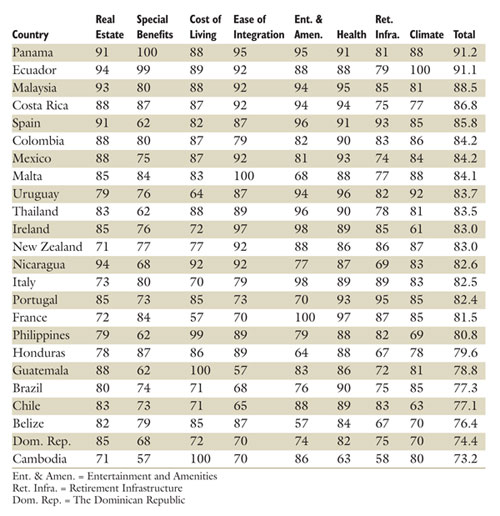
We decided to use the 2014 International Living 2014 Global Retirement index as a comparison,

Global Annual Retirement IndexCourtesy of International Living

International Living uses the following categories to rate each country:

  1. Real Estate: Countries where real estate prices are low and the purchase of real estate is relatively easy receive good scores
  2. Special Benefits: This category considers government provisions that make moving to and living in each country easier and more affordable for foreign retirees.
  3. Cost of Living: This score is based on information collected by International Livings editors and contributors.
  4. Ease of Integration: International Living looks at the degree to which English is spoken, the friendliness of the locals, the size of the existing expat community and the availability of home comforts.
  5. Entertainment and Amenities: The ranges of activities open to expats. Ratings include restaurants, movie theatres, outdoor activities and local music and art.
  6. Health Care: Considered in this category are the cost of health care and the quality.
  7. Retirement Infrastructure: This category considers; the quality of the roads, the availability of good public transport, the number of cell phones, Internet penetration, and how easy it is to get to and from the U.S. and Canada by plane.
  8. Climate: Countries with temperate weather throughout the year, moderate rainfall and little risk of natural disaster come out on top in this category (Hurricanes can ruin your day!)

Live and Invest Overseas uses the following categories in their index:

  • Climate
  • Cost of Living
  • English Spoken
  • Entertainment
  • Environmental Conditions
  • Existing Expat Community
  • Health Care
  • Infrastructure
  • Real Estate
  • Residency Options
  • Safety
  • Taxes

Introducing The 2014 Your Escape Blueprint Perfect Abode Index …………… Drum roll please!!!!

2014 Country Index

Note; we added The United States and Canada for reference.

To give a more extensive or rounded view, we included some of the categories used by International Living as well as additional categories using other people’s information such as the United Nations, The Human Security Index , The Heritage Foundation, and Education First.

The International Living Categories (and numbers) we used in the Perfect Abode Country Index include:

  1. Special Benefits: 
  2. Cost of Living:
  3. Retirement Infrastructure:
  4. Climate: 

In addition to the four International Living categories, we used the following five of our own.

Security: It’s not much fun living in a country where the biggest source of gossip among your expat friends is who was robbed recently. To give each country its score we used the information from The Human Security Index 

Health: We decided to use the United Nations Human Development Health Index to rate individual countries. 

Property Ownership Rights: What good is it, if property is inexpensive but a nightmare to purchase? We spoke to many expats in Panama and Belize with horror stories about buying property. We used the information provided by the Index of Economic Freedom; an annual guide published by The Wall Street Journal and The Heritage Foundation to rate countries property ownership rights.

Freedom from Corruption:  In some countries, ripping people off is a sport. Corruption results in daily frustration, especially when you are unable to speak the language. We used the information provided by the Index of Economic Freedom, to rate how free each country is from corruption.

English Spoken Index:  Moving to a new country is a challenge in itself. Moving to a new country where you do not speak the language is more difficult. We used the Education First English proficiency Index to rate countries on their adult English proficiency levels.

This is not to deride the valuable information provided by International Living and Live and Invest Overseas. If it were not for them, many people would never even consider leaving home. Many people have successfully and happily retired to countries that score high in the corruption and property ownership rights issues. However, it is a reminder for you to look at the whole picture–including the sharp prickly bits—and do your research and planning accordingly.

Please remember the map is not the territory – go explore. The more time you spend in a country the better idea you get about what makes it tick and if it is a fit for you and your requirements.

As always we look forward to hearing your thoughts and experiences.


0 comments

Avoiding the Rip offs in Cartagena, Colombia.

Like many a visitor, we had done our research and were expecting to be mobbed by beggars, pickpockets and touts as soon as we left the cruise ship terminal in the port of Cartagena.

This may be why so many visitors decide to stay on the ship all day and never actually step foot in this fascinating city. This was our first opportunity to visit not only another new country but also an entirely new continent, we were determined not to miss it.

Cruise ship guests are often taken advantage of, as the residents know they are there only for a few hours and “have a lot of money”. We had decided against the ships pre-booked, pre-arranged tour itinerary, we wanted to do our own exploring. We disembarked late in the day and were pleasantly surprised by the facilities in the cruise terminal. There is an extensive garden area with semi- tame Macaws, Flamingo’s, Peacocks, Parrots and Hawks. There is also a restaurant, with lots of outdoor seating and a large Wi-Fi area—one hour for $3 US—distinctly preferable to the 85 cents per minute on-board.

cartagena cruise ship terminal

However this delightful oasis was cunningly set up to deliver the unsuspecting tourist right into the arms of the “tour touts”. Follow the exit signs and you will be pounced upon like a hawk hooking a mouse. These guys are very slick, they speak excellent English and want to show you their beautiful city, a 2 hour tour for only US $80. (Bus tours booked onboard were $50 per person).

This is where doing a little homework in advance comes in useful. We had already spoken to the lovely woman at the tourist information desk and had asked what a taxi into the old city should cost, by law they are only supposed to charge $6 from the terminal.

Imagine our surprise when after explaining that we only wanted to go into the old City, these charachters told us that a taxi cost $30 one way! Therefore their tour was such good value………..

After saying no and telling them that we knew it should only be $6, most of them just walked away, waiting for the next, less informed passenger to come along no doubt. Undaunted we retraced our steps and easily found an alternate exit (looks like a taxi drop off point). From here, we easily found the port gate and headed out in search of a taxi.

Shortly after Johnny joined us, a local retired fisherman who makes a little pin money finding taxis for the tourists. With his cut, the taxi ride was $10. This was fine by us; we have spent enough time travelling to know that a stranger seldom gets the same price as a local.

Surprisingly Johnny jumped into the cab with us and exhorted us not to change money on the street, as we “would be robbed and to be very careful”. All calculated to ensure we took him up on his offer to show us around the city at no cost. Although his English was not as perfect as the touts, he directed us to the Simon Bolivar Park, the Inquisition Museum, the carving of a generously proportioned female–serving as a warning to all Cruise ship passengers–then a detour into an Emerald shop before heading up onto the walls surrounding the city.

cartagena

Strangely, we saw no beggars.  Travel guides and past visitors recount tales of the hordes of beggars that cluster around the turistas, we saw none!

I asked Johnny “where are the beggars?”, his answer–which I have been unable to substantiate–is that “the President did not like the beggars and their monkey business, so he told the police to round them up and then they were killed”.

Hopefully, the solution was not as drastic as Johnny’s version suggests.  During our time there, we did not see a single beggar; there were street vendors, selling hats, leather goods and cold drinks but no beggars. Maybe they were moved out of town and roam the nearby beaches?

Our taxi back to the boat was another $10 and with a tip to Johnny our own personal walking tour of old Cartagena cost only $25 and a little ingenuity. It was worth the time and the money to see this fascinating city with its colonial architecture and ancient walls, sharply contrasting with the  sprouting towers of modern Cartagena.

Lessons learnt— Do your research beforehand and be willing to explore even if the reputation is a little unsavory, you may be pleasantly surprised.


4 comments

Cooking Country Style in Panama

Part of the fun when visiting a new country is learning a few of the local dishes. This gets even better when the chef is also the friendly neighbor.

According to our chef Victor, everything tastes better when cooked over an open fire and we have to agree, especially when washed down with a few cold Balboas.

The mainstays of Panamas comida typica is Plantain, Cassava,  ñame and of course chicken pollo.

Patacones appear on every menu and thick slices of plantain, fired till golden then squashed and fried again. They are starchy, filling and a perfect accompaniamnet to Victor’s famous fish fry. The secret to the fish fry is his marinade.

Marinade recipe

Garlic & Culantro (Central Americas version of Cilantro) finely chopped then blended with salt curry powder and lots of lime juice. Score the fish so the marinade can penetrate and chill for a few hours. Dip in seasoned flour before deep-frying. When crispy and golden, drain and serve.

Sancocho de Jardin is also a Panamanian tradition, it means soup of the garden and most of its ingredients are found in gardens throughout Panama including the garden reared chicken.

The secret to a good Sancocho is the long cooking time, each ingredient is added separately and allowed to give up its flavors before the next is added.

Sancocho de Jardin

First bring a big heavy duty pot full of water to the boil add each ingredient in the order listed and enjoy.

  • Two or three finely chopped red chillies (most chillies here are fairly mild) and a little finely chopped tomato.
  • Half a onion and 4 cloves of garlic finely chopped
  • Chicken, skinned and chopped into chunks (feet, neck and head will often be included)
  • 2 tsps salt. (to be authentic this should be a garden reared chicken, although it seems to work well with the store bought kind)
  • Once the chicken is well cooked, add ñame (a ugly bulbous root vegetable, slimy when peeled and raw, yet delicious when cooked) also add a chicken stock cube and 4 culantro leaves roughly chopped.
  • Once the ñame is cooked, serve immediately (overcooked ñame dissolves into shreds)

Serve up a big bowl with a pot of rice to hand as many people like to add rice to it.

When faced with a bowl for the first time you may be tempted to ask for a knife and fork, stick with tradition and use a spoon and your fingers. You will be back for more!

Thanks to Elaine and Daniel for sharing their home and introducing us to the best neighbors anyone could have. Thanks also to Victor, Ursula, and the rest of the family for making us feel so very welcome and sharing their recipes.

Hasta leugo mis amigos

Dinner is Ready
0 comments

The Wests – Committed to Community

If you have ever dreamed of escaping the 9 to 5 and following your dreams and then doubted that you could, remember others have already! Allow us to introduce you to more of our fellow “Escapee’s”.

Many people when considering early retirement overseas, focus on the climate, the amenities and the cost of living. What we have discovered is that the community you live in is also extremely important.

One couple we met recently epitomizes the sense of community spirit. For them their new home is not just the location but also the community around them.

Robert and Cynthia West–both from Hawaii–have lived and worked the majority of their adult lives in California. His work has taken him all over the world, allowing them to explore many potential retirement places. They loved Tahiti and France, however both were too expensive and Tahiti was too hot as well.

Rob & Cynthia-6

They had been visiting Panama since 2003 and had decided this was to be their retirement home.  They were “looking for a warmer climate, with a swimming pool” and adds Robert ”somewhere that the climate suits our clothes, shorts, tank top and flip-flops”. They bought their large, sunny three-bedroom condominium with glorious views of the Pacific Ocean and the sparkling sands of Playa Blanca, on the Azureo peninsula in 2005.

They decided on this location because of its closeness to Panama City and the new Scarlett Martinez airport in nearby Rio Hato. The goal was to be able to split their time between the beach and a home in the mountains. The first piece of land they bought became a nightmare, rather than a dream, due to Panama’s somewhat convoluted land ownership titles. Undaunted, they later purchased a beautiful ocean view lot high in the mountains.

Plans to move to Panama permanently halted after the crash of 2008. With a much smaller 401(k), retirement would have to wait. Robert went back to doing some part time consulting and Cynthia soldiered on at her high stress 10-hour-a-day job in Silicon Valley. They visited their little slice of paradise as often as they could and dreamed of the day when they could move permanently to Panama.

It was late 2012 when Cynthia (59) bounced through the door vibrating with her news. Her company’s plan to inject some younger blood into the workforce meant a very tempting early retirement package for her. Robert (62) listened with mounting glee as this “avenue of escape” gave them the opportunity to retire permanently.

They moved to Playa Blanca in February 2013, and have really become part of the community here.

Rob & Cynthia-10

Sitting in the shade of their balcony Cynthia explained. “We have our own pool and yard, with none of the work; we are friends with the staff and have a busier social life than back home”. With their positive upbeat attitude, it is no wonder that they have such a huge network of friends.
Cynthia often leads the thrice-weekly water aerobics class and Robert is always willing to step in and help as needed. This is often translating for those still in the “Tarzan” Spanish stage or providing a ride into town to pick up groceries.

We were witness to the unstinting and ongoing help they provided during a recent medical emergency. Their help was invaluable; Roberts EMT background and quick response meant timely attention. They also provided transport to and from Doctors and Hospitals and translated as needed. Without their assistance, this traumatic event could have been much worse for everyone involved.

To them community is not just their expat neighbors, it is the entire local community. They get huge satisfaction from sponsoring two local school children, “knowing that they are helping them get a higher education and a brighter future for only $30 a month is priceless” says Robert. One of their sponsored kids is a ‘grade A’ student, they are very proud of her accomplishments. When they found out she needed a computer at her new school, they stepped in to support her and her parents.

It is this sense of community that has made them decide that the beach is where they want to be. They are selling their San Francisco Bay home and their mountain lot.

Many of their family and friends, inspired by their new lifestyle, have visited and some are seriously considering retiring here too. They advise people to “live here for at least six months, do your research in advance and commit to being part of the community”.

Instead of spending their days tracking projects, costs and man-hours in the corporate world. They still have busy and full days. Interests include stargazing from the rooftop terrace, hunting for shells on the beach or visiting local restaurants. Cynthia has taken up painting once again and her artwork decorates the walls, as does her stunning photography.

Playa Blanca is a great base for them to explore from. Day trips to the picturesque town of El Vale and La Pintada are easy to do. They visit all the local festivals and events and happily share the day with newfound friends.

Rob & Cynthia-2
0 comments

Are You Ready For A Medical Emergency?

A few days ago, I witnessed an event, which would devastate and shock an entire family and a small community.

At the end of a far, from strenuous water aerobics session, one lady developed a “pounding headache”. Within minutes she was comatose at the side of the pool. The events that followed can happen anywhere and anytime. Yet how many of us are prepared for such an event?

An EMT trained resident arrived and was able to get her into a ‘recovery’ position and reassure her that help was on its way. The resident nurse arrived and called for an ambulance, then accompanied the patient to the hospital. However, she was unable–due to low blood pressure– to get an IV into the patient.

Ambulances in this part of Panama do not come with Paramedics. They are solely for transporting patients to whichever hospital or hospitals they are affiliated. Many North Americans and Europeans assume that once an ambulance has arrived, that medical assistance will commence. That is not the case here.

The patient—by now awake and ambulatory—arrived at the nearest hospital. Where she was diagnosed with a migraine, given two Tylenol and sent home.  The following morning after a night of vomiting and intense pain, she saw Coronado’s popular Doctor Levy. He sent her to the nearby San Fernando clinic for an EEG and a CAT scan. The EEG was satisfactory, but she was unable to get a CAT scan (as they were having some problems with the equipment). They were advised that the nearest scanner was in La Chorrera’s hospital 30 kilometers south west of Panama City.

Imagine the chaos of any emergency room, add the extra demands of a Saturday and complete the picture with (naturally) only Spanish speaking staff. Thankfully, one of her companions had a good grasp of Spanish and was able to insist that this was serious and that she needed attention. They admitted her, and set her up on an IV while they waited for the CAT scan. After waiting over 3 hours, they left without a scan, because it was “too expensive and unnecessary” despite the fact that it had been requested by her Doctor. Following her discharge, the Doctor in charge of her case at the hospital refused to discuss the case with Doctor Levy.

The patient rallied briefly over the weekend but by early Monday needed to see Dr levy again.  This time a CAT scan was performed. It showed evidence of hemorrhaging, confirming that she had had an aneurism. She went immediately to Punta Pacifica hospital in Panama City,  the emergency staff had been advised and were expecting her.

Here a well-run and efficient hospital kicked into gear. Following a day of further testing and discussion of options, surgery was scheduled for the next day. The procedure went smoothly and she appeared to be rallying well.

However, the worst was yet to come. A second procedure was scheduled which did not go as well. One week after the sudden headache, she slipped into a coma.  Three days later her loved ones—who were impressed with the high quality of care provided at Punta Pacifica–had to make the decision to let her go and honor her wishes for donating her organs.

Would this have happened if she had prompt medical attention? No one knows.  These cases happen all over the world. This is not about beating up any one medical system.

This is a lesson learnt. Many of us ensure we have adequate medical and travel insurance. Nevertheless, do we know what to do in an emergency?

Here are a few questions we will be asking whenever we arrive at a new destination.

  • Is there a nurse or Doctor on site?
  • Where is the nearest hospital?
  • Does it have the necessary equipment for the type of emergency?
  • What are the emergency numbers?
  • Does the ambulance have a paramedic onboard?
  • How would you get the patient to the hospital?
  • Is anyone available to translate if you do not speak the local language?

Concerned members of the local community are compiling a comprehensive list of Emergency numbers to be posted in prominent positions.

One further recommendation is one we will be using.

Write down any allergies you have, any crucial medical history and a list medications you take. Then get it translated into the local language and keep this with you at all times.

One of the reasons we set out to explore the world is because ‘life is too short” and as this highlights, illness can strike at any time, any age and anywhere.

Life is to be lived!

I hope that the lessons learnt on this ladies passing will benefit many more people than those who receive her organs.

She was a well-liked and respected person, sadly missed by all who knew her. May she rest in peace.

Time to Dare


0 comments

Belize, a Tax Haven? – I am not convinced

Geographical arbitrage has become a big business. As baby boomers are getting ready to retire, they are looking for places to make their retirement budget go farther.

Many companies make a very good living assisting people in making the move. These companies are experts at selling memberships, magazines, information products, seminars and even real estate. When doing your research for finding your perfect abode in the sun – be very careful whose advice you are listening to, and be very aware of who this information is actually benefitting.

One of the “selling features” of Belize is that it is an off shore-banking haven – I call bullshit on this.

ST Georges

Sure Belize’s International Business Companies (IBC) Act allows international investors to establish offshore companies in Belize. Sure, Belize may have a banking act that ensures banking secrecy and higher liquidity rates – But for this Gringo there is no way I would hide my hard earned money in Belize’s banks.

There is another side of the coin –  the side not shown on the slick webpage copy.

The reality is that the government of Belize is flat assed broke, with public sector debt above 70% of GDP.  Belize also has a track history of defaulting on its loans. In September 2012, Belize defaulted on its external debts totaling approximately US$554 million.

Besides not paying its bills, the Government of Belize has also expropriated businesses owned by foreign investors. In 2011, the government passed special legislation, which resulted in majority government ownership of utility providers (including water, electricity, and telecommunications).

“Belize Telemedia Limited (BTL) is Belize’s telecommunications provider. In August 2009, the company was nationalized by the Government of Belize, who appropriated 94% of its shares which were previously controlled by Michael Ashcroft”. (Wikipedia).

Fortis a Canadian based power company had assets worth an estimated $125 million expropriated by the Government of Belize.

These are big companies with expensive lawyers and deep pockets.

The following is what the Index of Economic Freedom, an annual guide published by The Wall Street Journal and The Heritage Foundation has to say about Belize:

“Belize’s economic freedom score is 56.7, making its economy the 115th freest in the 2014 Index.  Belize is ranked 21st out of 29 countries in the South and Central America/Caribbean region.

Over the 20-year history of the Index, Belize’s economic freedom score has declined by 6.2 points, the 12th largest rating deterioration. The gains achieved in trade freedom and the area of government size that measures fiscal freedom and government spending have been outweighed by substantial declines in investment freedom, property rights, and freedom from corruption, all of which deteriorated by at least 30 points over the same period.

Registering its lowest score ever in the 2014 Index, Belize’s economic freedom status remains “mostly unfree.” Economic dynamism is constrained by institutional weaknesses that undermine prospects for long-term broad-based economic development. In particular, the judicial system remains inefficient and vulnerable to political interference.

Corruption is seen as widespread. Business owners complain that government officials, including police and others, often solicit bribes or show favoritism. The court system, although constitutionally independent, is often influenced by the executive. Expropriation of personal property is relatively rare, but the current government has expropriated major private foreign-owned electricity and telecommunications companies”.

This would be my advice before setting up an off shore account in Belize.

Get a written guarantee from the banks head office – not the Belizean subsidiary. You want a written guarantee that your funds are safe if the Belizean government goes after your cash. Please let us know if you have any luck with this.

When the Belizean oil fields dry up and the Government of Belize is desperate for cash they may come knocking at the door of your “secret bank account”. If Belize decides to expropriate cash and you cannot afford the expensive lawyers all I can say is “Good luck getting the government you were hiding our money from to help you get it back”.

There are other tax havens in the world, including Switzerland, The Isle of Man, Guernsey, Bermuda, the British Virgin Islands, The Cayman Islands etc… Maybe you may want to check their track records too before deciding where you hide your hard earned money.

P1200912
1 comment
error: