≡ Menu

Your Escape Blueprint

What Will You Do, After You Retire?

We “retired” at the ages of 44 and 53, which makes us “early retirees” or does it?

The word retirement implies not only relaxing on the beach with rum cocktail in hand, but also the ceasing of productive work. Although we are no longer working on the corporate worlds 9-5 treadmill, we are still being productive. Over the last few months, we have learnt about wordpress, blogging, writing and photography and been paid for our work—guess we must still be doing productive work?
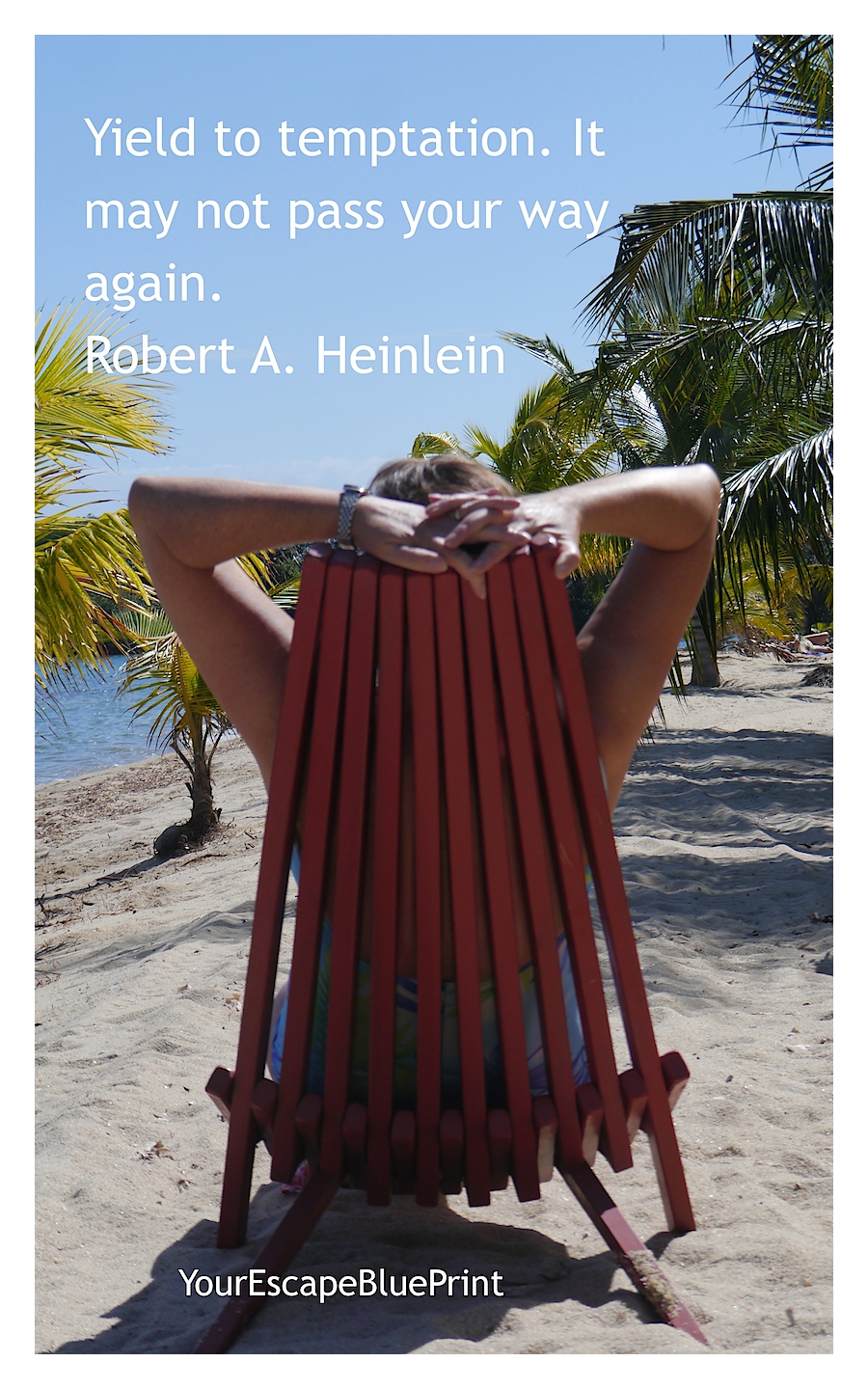
retire early

Like many people who want to “retire early” we were driven by what we wanted to escape from—drudgery, stress, boredom, monotony–we wanted out of the “rat race”.

We also knew what we were retiring or moving toward—a better quality of life–time to travel, to pursue hobbies and unfulfilled ambition. Seeds planted by my English teacher years ago have begun to grow, I have time to explore what he saw in me and become the writer he nurtured.

One of the family surprised us by following Michael’s footsteps into engineering. surprising because at 8 years old he was going to be an entomologist. Will he like Michael realize twenty years into his chosen career that he is on the wrong treadmill, should he have gone for entomology after all?

In my prior career “financial freedom” was a term used a lot, after all, “financial freedom” will allow you to retire early. Or will it? That depends on whether you are moving “toward or going away”.

There is an important difference, “going away” goals and dreams, lead to temporary satisfaction or happiness–a honeymoon–without purpose, discontent will eventually set in. Stories abound of successful entrepreneurs retiring in their thirties and forties, only to find themselves bored, frustrated and looking for something new to do.

“Going toward” goals are what lead to long-term happiness and fulfillment. If your reason for getting off your own personal treadmill is to make space, time and freedom to do something that you really enjoy, whether that is volunteering, or an entrepreneurial dream then it will never be “work” because you will be doing something that “juices” you.

I really enjoyed reading this financial planners views on the subject, (I did borrow his terms going away and going towards, as it sums it up so well). I also agree that if you really want to do something different with your life, you do not have to be “financially independent”, however you do have to be willing to make some changes in your life.

“Twenty years from now you will be more disappointed by the things that you didn’t do than by the ones you did do. So throw off the bowlines. Sail away from safe harbor. Catch the trade winds in your sails. Explore. Dream. Discover.” ~~ Mark Twain~~

As always we want to hear from you, are you “moving toward” or “going away”?

0 comments

Experience a Different Life Go House Sitting!

Perched high above the Belize River, shaded by the towering mammoths of the jungle, sits this three bedroom, two bath home. Large screened windows let in the light, the breeze and the view!

Hummingbirds dart like mini “Jetsons” back and forth from the feeders, toucan’s craakk, craakk , and howlers screech above the constant trills and calls of the myriads of hidden neighbours.

P1190684

With no human neighbours and no streetlights, we sleep like logs. A walk around the grounds rewards us with fresh lemongrass, jungle chillies, limes, mango, avocado, passion, and dragon fruit.

We are fortunate to have another house sit, here deep in the jungle near Belmopan, Belize. How else could we experience this?

This is hard to match. A neighbouring resort boasts a jungle retreat, yet guests look out over manicured lawn to the river below. The closest glimpse they will get of a howler monkey is the troop across the river. Despite the hefty price tag, they cannot sit and watch our “troop” of howlers as they navigate across the coconut palm that connects their two favourite trees.

Howler-4

We do have responsibilities of course….. in this case our charges are all delightful characters who have accepted us into the pack. Our duties involve feeding them, a quick brush and lots of fuss, not a hardship in returning for living comfortably & free in the middle of the jungle.

P1190719

We started house sitting in May 2012, since then we have stayed in a 15th century Tuscan farmhouse, a vineyard in France, a casita with pool in Spain, a home with a stunning Volcan Baru view in Panama, a small resort on the lagoon in Placencia and now here.

House sitting is how we keep our travel costs down, which means we get to do more travelling and meet wonderful people. Some of them, inspired by our success have decided to try house sitting for themselves, they have “sits” lined up in France, Grenada and Costa Rica, no cold winters for them.

To find out exactly how housesitting works,  simply sign up for our monthly newsletter and receive your FREE Report.

We love house sitting and our homeowners seem to love us! To find out why they all ask us back, check out Yvonne’s recent guest post at Trusted Housesitters.

As always we would love to hear from you, where would you like to house sit?

0 comments

What the Frick was that?!

There comes a point when you ask yourself am I truly alive, or just a robot going through the motions?

I found myself asking this question with increasing frequency as I approached the 20th year of an engineering career.

Staggering out of bed at 6.30 am, rolling into my office after pouring the first of my pints of coffee, I often had no re-collection of the drive in.

Familiarity with the same old routine is blinding.

Had it been a beautiful sunrise? I would have no idea–I may have remembered that the traffic was bad–other parts of the day would pass in the same daze, as would the commute home.

A robot, could have performed many functions of my everyday routine. Even though I was not working on an assembly line or working from a tiny cubicle I was becoming an automaton in many respects.

Travel has been an excellent antidote for waking from the monotony, that everlasting hollowness of the daily grind. When I travel, I find that I am more aware of my surroundings. I have the time to focus on what is immediately around me – not what is on TV, the computer screen, or being told by someone else what is important.

As I write this, I can see howler monkeys forage in the trees outside, not only do I have time to smell the aromas of a green freshly washed jungle, I have the time to enjoy the alien sounds that surround me. I hear the shifting waves of the cicadas and the birds claiming their territory.

Howler-6

Belize is a country of exotic sounds that lull you to sleep and waken your senses. In Placencia,  the cacophony of a frog orgy during the recent summer rains stays with me. The chorus started at dusk and went well past my normal bedtime.

The local troop of howler monkeys living in the trees just steps from our current housesit think it’s cool to whoop it up at two in the morning. Their roaring travels for miles, hearing it come from just above your bedroom window is an awakening in many senses.

In our fast-paced modern life, we are often in such a hurry – our senses overwhelmed and they often shut down. By making, the space and the time to conquer my robot,  my senses have developed and grown more acute….. or maybe I am just more aware?

0 comments

Lobsterfest comes to Placencia

The mega 3-day beach party like, no other in Belize is the boast of Placencia Lobsterfest organizers! Having witnessed first-hand the events of June 28, 29 & 30th 2013 we have to agree, after all they have been running this show for 15 years now.

We arrived in Placencia on the 26th and plans were already well under way, a huge marquee covered the forlorn huge concrete pad, which sits seemingly forgotten for the majority of the year. The wide sand corridor beyond, sprouted exotic fungi, as if the steel tubing had taken over and sprouted at will.

The excitement built as people poured into the village, already an eclectic mix of people, the population swelled with tourists and locals from other parts of Belize. As the population swelled so did the music, no mere toe tapping tunes here, if your hips aren’t swaying you may want to check your pulse…….

Festivities started with a Big Bang! Oops should that be Big Band! Actually no, a Big Bang is exactly what it is, every band we have seen is heavy on the drums and they know how to use them. Check out the folks in the nifty blue and white outfits and pity Mikes tortured ear, as the trumpets go by.

Brass bands, steel bands, skin drums, traditional songs, bands, bands and more bands played into the wee hours. Performers and audience alike, slaked thirsts with copious amounts of Belikin Beer and the local rum, discarded prickly and hot bottle caps soon became a hazard to all those bare feet.

Lobsterfest-6

The star of the show and the reason for this frenzy is the re-opening of lobster season. These spiny critters have had a short respite from the on-going demand for their tender tails; the moratorium on harvesting is to give them time for a little romance and a lot of procreation.

Lobster grilled, fried and stewed, in soup, balls and pizza is everywhere. Discarded shells, heads and legs spot the beach and overflow from the trashcans. For those not into the spiny crustaceans other options include chicken and sausages on sticks. Also on sticks, electric blue candyfloss for the sweet toothed.

Aside from the bands, lobster and beer, local craftsman and vendors set up to sell their wares. The carved bowls, masks and carvings are exceptional, painstakingly carved, sanded and polished by very talented hands. Complementing the entire assemble is a smattering of local charities, businesses and environmental groups (wearing a shark outfit in that heat is true dedication to the plight our fearsome friends face). Be sure to bring cash with you and take your chances at the raffles and games who knows you might win the round trip airline tickets to the states or win the Tuna Toss! (Not a real wet slippery Tuna only the heavy stuffed mascot from a local bar).

If you get the chance to visit this charming, sleepy, little fishing town next year we suggest you arrive early and watch the transformation. Be sure to reserve a room though.

Lobsterfest-8
0 comments

Turtle Love on Playa Bluff

Outlined against the white crash of the surf the behemoth lurched herself out of the freshly dug crater, turned her nose to the waves and headed for the safety and security of her usual habitat.

After a starlit, walk along Playa Bluff, Bocas Del Toro, Panama this was the sight that rewarded us. The Loggerhead turtle is a creature of the oceans. Her whole life–apart from the first few perilous minutes of emerging tiny and defenceless on this very beach–is spent in the gentle embrace of the seas, until the drive to reproduce calls and she crawls, heavy and cumbersome up an ever-changing beach, in search of sand dry enough to lay her 100-130 eggs.

She repeats this feat many times, especially if her first attempts to find a suitable spot fail. She will try further along the beach or another night, if stressed and exhausted, she may release her eggs into the ocean, never to hatch. One aborted attempt is not the end as a female may mate and lay up to 9 times in a season (a season may be every 2 to 3 years)

Out of the potential 1000 to 1300 eggs laid, only one hatchling typically makes it to breeding age. When you consider that breeding age is 14 years or more, this threatened species needs all the help it can get.

 photo SarahBradley-1.jpg
Photo by Sarah Bradley

The invitation to go on our first turtle watch was a delight and honour. Dressed in dark clothing we were picked up ay 10pm and bundled into a van for the drive along the partially washed out beach road.

With no light other than the stars and the fleeting glitter of phosphorescence underfoot, we made our way down the beach. Our guide pointed out one aborted nesting site, the partial hole and ridged flipper tracks evidence of the turtles struggle against the weight of gravity.

Our labours were rewarded with the siting of one large female Leatherback, who had chosen a narrow section of beach to dig a nest. Each species of turtle has specific requirements for the location and moisture content of the nest site, this site was obviously too wet causing her to abandon her efforts, and head back to sea.

Leatherback Sea Turtle | Daniel Evans, Sea Turtle Conservancy photo DanielEvans_STC-Leatherback-Suriname_zps16ac208f.jpg
Photo by Daniel Evans

Witnessing a turtle laying has long been on my wish list and evidenced by the number of visitors coming to this site every year, I am not the only one. A tour taken here just a few years ago would have been very different, large noisy groups and powerful flashlights were common and very disruptive to the light and sound sensitive females.

A recent initiative aimed at providing carefully guided tours, while collecting scientific data and protecting the areas turtles is having great success.

These nighttime tours of the beach offer visitors the chance of observing a nesting turtle. Tours cost $15 to non-Panamanians, $10 to nationals and $8 for members of the local community.

The proceeds meet the initiative’s goal “to create an economic alternative for the local community while ensuring the protection of sea turtles and their nesting beach”. The money generated pays the monitors, guides, and supports the turtle conservation effort.

The monitors, gleaned from the local community, are one of the major reasons for the program’s success. Patrolling the beach nightly and collecting scientific data on the nesting turtles, their presence also help protect against the poaching of the eggs and turtles.  Their duties also involve being vigilant for any harmful activities, such as dogs and other animals digging up nests or ATV’s on the beach, as the weight of these vehicles impacts the sand making it impossible for the turtle hatchlings to dig themselves free.

The monitor’s nightly vigils and the watchful daily presence of this beachside community appear to be working. In the last four years, there has been a steady increase in the number of undisturbed nest sites. The stretch of beach receives approximately 300 leatherback nests, a 100 hawksbill and a growing number of green turtle nests.

For tickets or information, visit the office at the municipal market, open Monday to Saturday 12.30 – 6.30pm. To check availability visitors may call 6996 0608. Tours must be pre-paid to secure a place due to the limited number of visitors allowed each night.

Group numbers are limited to eight people and there only two tours each evening. Cameras and flashlights are prohibited, other than the guide’s red light. Turtles do not see red very well, effectively making it almost invisible and therefore less disturbing to them. Unfortunately, they cannot guarantee that you will witness a turtle nesting.

The guides and monitors enthusiasm for the project is contagious, as you will see for yourself if you are fortunate enough to visit during the March –August Turtle season.

If you are lucky enough to observe a female laying her eggs, you can rest in the knowledge that your presence is helping to protect, not destroy, these ancient creatures.
Green Sea Turtle |  Credit Rod Dillon photo RodDillon-1_zpsbe9806b7.jpg
Photo by Rod Dillon

0 comments

Freedom 55

Yes, I have hit the milestone of 55 and as with most birthdays spent a little time in reflection. This is when the well known phrase “Freedom 55”, a name still used by a division of the London Life insurance company, popped into my head.

In my twenties and thirties, I remember a barrage of advertising, featuring good-looking couples in their fifties, doing fun things such as cycling, and sailing, bouncing grandchildren and enjoying themselves, all without a care in the world. None of them were stuck in traffic or chained to an office desk.

Why then are so many, still chained to their work into their sixties and beyond? Is the cause, the economic crisis, falling interest rates, rising interest rates, global warming? I am sure there are many answers and opinions on this, after all if it was so easy we would all be retired, we would all be free or would we?

For the last sixteen months, Michael and I have been “free”, free from the routine of work, free to travel, free to work on our bucket lists and free to explore new ventures. This is not because we won the lottery or where independently wealthy but because we made the biggest decision of our lives.

We decided to reinvent ourselves. One of the biggest challenges we faced was to learn to think of ourselves as something other than our usual professions. Michael has been an engineer for 27 years–he has invested in that identity–throughout university and his working life that is how he thought of himself. To change that identity, to become something else or do something else, is a huge challenge for many. Is that ingrained sense of identity, so strongly linked to a person’s profession keeping them from achieving their freedom? Or is it the fear of change?

Change is frightening; we know we went through it. What we also know is that change is necessary for growth, after all a plant grows or it dies. I was 53 years old when we started on this change, this growth; it has been uncomfortable, scary, demanding, exhilarating, fulfilling, sad yet funny and very enlightening.

At 55 years of age, I have freedom to follow my bliss, to do what I want to do, whether that is, sleep in, write or stroll along the beach. Even if it does involve some perturbation Freedom 55 is obtainable.

We look forward to hearing about your challenges and successes, have you made it to freedom?

P1040564
0 comments

The Panama Canal – The Big Ditch

Do you have a bucket list? If so what is on yours? Does it include like mine “The Big Ditch”?

With my engineering background, being in Panama meant having to see the Panama Canal. The best way to see this engineering marvel is either to transit the canal on one of the cruise ships passing through, or to get a closer look by tour boat. We took the tour boat, which gives a more personal and up-close perspective.

Our tour starts at Gamboa and heads east to Panama city and the Pacific Ocean aboard the Panama Marine Adventures “Panama Queen”. The trip was a highlight worthy of its place on many “Bucket Lists”.

Panama Canal

The Canal is a manmade waterway, 50 miles long — that connects the world’s two largest oceans.

According to the American Society of Civil Engineers the Canal is considered one of the seven wonders of the modern world along with the:

  • Channel tunnel
  • CN Tower
  • Empire State Building
  • Golden Gate Bridge
  • Itaipu Dam in South America
  • Delta Works/Zuiderzee works in Holland

The French first attempted to build a canal through Panama in the 1880’s, after almost ten years of struggling to dig what amounted to a big ditch across Panama the French left. Panamas thick jungles full of snakes, bottomless swamps, and mosquitoes carrying malaria and yellow fever, claimed the lives of 20 000 workers.

When the Americans tackled the project in 1904 they decided to build the canal with a large dam and lake system. The plan included the building of three sets of locks used to raise ships 85 feet to the level of the reservoir and then lower them at the other ocean. The use of the lock system and the creation of Gatun Lake  reduced construction time by years. It also addressed the problem of the significant differences in tides between the two oceans.

Panama Canal-3

By the time the canal was complete in 1915 it had cost the US  10 years of construction time,  $350 million,  and the loss of over 5,000 lives to complete this colossal engineering project.

Not only was the building of the canal a triumph of engineering and technology over nature, the building of the canal was about exerting American power outside of North America. For President Roosevelt, connecting the two seas — the Atlantic and the Pacific –would galvanize the US as a global power.

Before any work could begin, the US had a small detail to resolve. At the time, Panama was a Province of Columbia whose constitution precluded giving away sovereignty. This led to the United States supporting a revolution by Panamanian elites, paying off Colombian troops with bags of cash helped to facilitate the revolution.

After this bloodless revolution, the US signed a treaty with the newly formed Republic of Panama giving the United States total control over the “Canal Zone”.

Since opening the Canal in 1915, almost 1 million ships have taken the shortcut between the world’s largest oceans.

Engineering Facts:

  • Ships traveling between New York and San Francisco save 7,872 miles and 27 days of transit time by using the Panama Canal instead of going around Cape Horn.
  • More than four and half million cubic yards of concrete went in to the construction of the locks and dams.
  • The locks of the Panama Canal are seven feet thick.
  • Since the Pacific tidal variation is significantly larger than the Atlantic (18 feet vs 2 feet), a sea level canal would be faced with the problem of a current running northbound when the Pacific tide was high and a current running south bound when the tide was low if the big ditch was completed.
  • In 1996 13,700 transits  accommodated over 198 million long tons of cargo.
  • More than 60,000,000 pounds of dynamite was used to excavate and construct the Panama Canal.
  • The dam constructed across the Chagres River in Gatun created Gatun Lake, the largest man-made lake in the world at that time.
  • A Panamax vessel is the largest vessel that can pass through the existing locks. A Panamax vessel dimensions are as follows:
    •           Length: 294.1 meters
    •           Beam: 32.3 meters
    •           Draft: 12 meters
  • Estimates are that 40% of the world’s container ships are too large for the present canal and close to 50% of transiting vessels were already using the full width of the locks.
  • A 5 Billion dollar expansion project is well underway to build two new flights of locks to be built parallel to, and operated in addition to, the old locks: when completed in 2015, the new lock chambers will allow the transit of vessels:
    • Length 366 meters
    • Beam 49 meters
    • Draft 15 meters
  • Each lock requires almost 27 million gallon of water to operate.
  • All of the water moves by gravity through massive conduits inside the lock structure. The diameter of the inlet conduit is 22 feet – almost 7 meters.
  • The gates, which separate the chambers, are enormous in size, ranging from 14.3 to 25.0 m and are (2.1 m) thick; each leaves weigh up to 662 t. The gates are hollow  and balanced such that two 25 hp motors are enough to move each gate leaf.
  • The existing gates are the original equipment which were fabricated by riveted construction.
Panama Canal-4


0 comments
error: