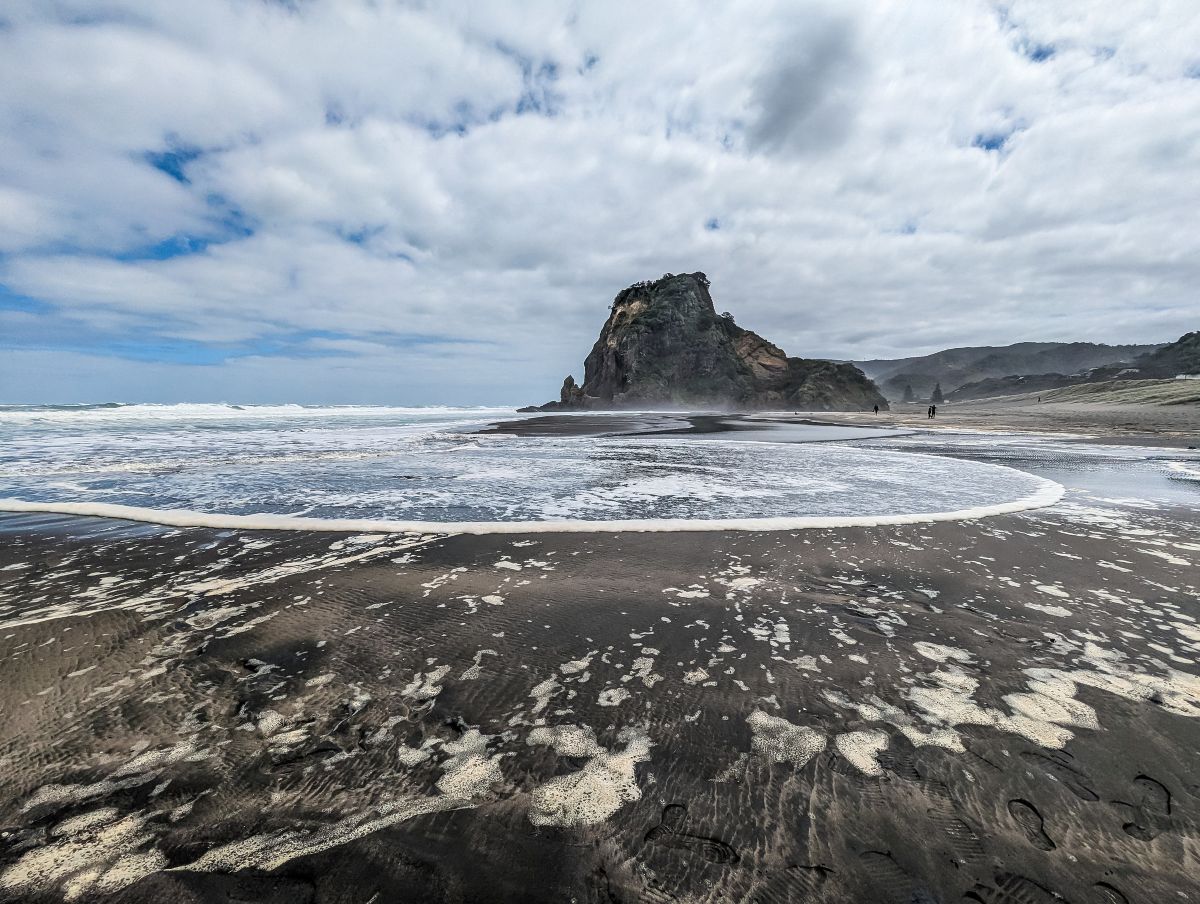
2025 was the second time Yvonne and I have been in New Zealand together. The first time was over 30 years ago when we met in Lake Taupo (well not actually in the lake but in the town with the same name).
This time around, rather than bouncing about as backpackers, we were housesitting in an upscale neighbourhood of Auckland for 2 months. We thought after the sit was finished it would be a great opportunity to revisit some of the places we travelled together in New Zealand three decades ago.
If you not familiar with the circumstances of the day we met you can read about the story of our interesting “first date”.
We arrived in Auckland at the beginning of September right at the start of New Zealand’s spring.
First Impressions of Auckland
In many ways Auckland reminds me of my hometown Vancouver, both are large metropolitan gateway cites, the places that newcomers often experience first when visiting a country. As with most cities, they are in some ways exceptions, rather than being representative of what the rest of the country is really about.
Auckland and Vancouver are both coastal cities defined by the Pacific Ocean with their bays, beaches, and bridges. Water plays a big part of life both in Auckland and Vancouver. Auckland has a fetish with sailing and is often referred to as the “City of Sails”. It is said that one out of every three Auckland households has a boat.
Both cities have beautiful scenic backdrops and the natural environment provides great hiking areas, beaches and scenic lookouts.
Aucklander’s and Vancouverites both embrace the outdoors and many people are engaged in an active lifestyle. Both places have an abundance of greenspaces, parks, and treelined streets.

Let’s Talk about the Weather
Both Vancouver and Auckland have mild maritime climates. Auckland’s climate is a wee bit warmer being borderline subtropical at 37 degrees South of the equator. This latitude is roughly equivalent to the boundary between Central and Southern California.
Similar to Vancouver it can rain sideways in Auckland! The thing we noticed with the Auckland spring weather is if you wanted it to change you usually only had to wait about 5 minutes. It was not unusual to experience 3 seasons in an afternoon. You can get whiplashed by the changes in the weather here.
Soul Crushing Traffic
Both Auckland and Vancouver have traffic that can test your will to live at times. There is significant urban sprawl in both metro areas, which means that getting around by car is often a necessity. Both metros have reliable public transportation – but reliable does not always equate to being convenient.
High priced real estate
Another thing Auckland and Vancouver share in common is a very high cost of living. Housing in both cities are at nose bleed levels of affordability. The availability of land is limited by the geography, that combined with high demand, equals expensive real estate.
Multi Culturalism
Auckland is very multicultural and is the country’s most cosmopolitan city. When it comes to multiculturalism Auckland and Vancouver are the same, but different.
Both cities have an indigenous population, in Auckland it is the Māori and in Vancouver the Musqueam, Squamish, and Tsleil-Waututh peoples. In Auckland (as the rest of New Zealand) Māori culture is very predominant and visible with place names, public art, and working language. Māori culture is foundational, and normalized, where as Vancouver is playing catch up when it comes to acknowledging its indigenous roots. First Nations culture is present in Vancouver but less embedded in everyday experience when compared to Auckland.
Both Cites also have a large Asian population (approximately a third of the population for each metro area). Asian Culture in Auckland is significant but they are more recent arrivals when compared to Vancouver. The Chinese, Korean, Filipino, and Southeast Asian populations in Auckland immigrated to New Zealand post 1990’s, where as Vancouver’s Asian population started immigrating in the late 19th–early 20th century, along with more recent waves.
One thing that is definitely different in Auckland is the large population of Pacific Islanders which include Samoans, Tongans, and Cook Islanders. Auckland has one of the largest Pacific Island populations in the world.
Another difference is in Auckland appears to be that it is more integrated and different cultures coexist side by side, where as the Lower Mainland has strong enclaves, or neighbourhoods which are more self contained and separate. For example, Little Italy in Vancouver, the Chinese in Richmond or the South Asian (primarily Indian) communities in Surrey.

Are the people in Auckland friendly?
Well – Yes and No
Polite – they can be. Overtly friendly – not particularly.
We didn’t exactly find Aucklanders approachable. We lived in a very nice Auckland neighbourhood for two months. Our experience was if you said hello to someone walking on the side walk 50% of the time, they would acknowledge you and the other 50% would completely ignore you, the numbers are skewed somewhat as some would cross the street to avoid you before you had the chance to say hello. During our two months stay, we did have a few conversations that consisted than more than a few niceties. The bottom line is, we felt socially isolated in Auckland.
The Kiwis on the whole appear to be a very decent people, but in Auckland as with most big city centers, people are reserved, and possibly just overwhelmed. Living in a city is about self protection. Constant stimulation, crowds, and demands on people’s attention, results in people having to detach emotionally.
I guess that is why I am not really a fan of cities – the more people crowded into a given place, the less friendly it tends to be.
The Sun Is Fierce
The sun in New Zealand is fierce! We have spent lots of time in the tropics but the sun in New Zealand feels different. The air is clear and is positioned beneath a thin ozone layer. You can feel you skin sizzling here, even on a cold overcast day.
New Zealand has one of the highest rates of skin cancer in the world. Sun protection is a way of life: hats, sunscreen, and finding shade is what you do (unless you are in your 20’s and invincible – then you lay out on the beach with minimal clothing).
There is a plethora of skin cancer clinics in New Zealand.
Two Islands One Nation
New Zealand is a nation comprised of two very distinct primary islands.
The North Island has the majority of New Zealand’s population and as we got out of Auckland and explored more, it reminded me of Ireland with it’s verdant green rolling hills and pastures. Unlike Ireland the North Island is punctuated by the occasional snowcapped volcano – and it is much sunnier than Ireland.
The South Island reminds me of British Columbia, just more compact. The population is much sparser than the North Island, the towns are smaller and spread further apart.
Always Something to Take Your Breath Away
Every day the there is something that makes you go wow! New Zealand has to be one of the most scenically beautiful places on earth. Definitely in my top 5 most beautiful places on earth.
The landscape of the South Island is dramatic and beautiful with it’s dominate alpine ranges that rise suddenly from glacial valleys, braided rivers, fjords, mirror lakes, stunning coastlines and clear blue skies (when it is not pouring rain that is).
When in the countryside admiring the scenery, you almost expect a hobbit, elf or some other mystical creature to appear onto the scene – and it would not seem out of place.

Amazing Bird Life
New Zealand’s bird life is what makes the country so distinctive.
For most of New Zealand’s history there were no mammals, apart from bats. The absence of predators meant birds became the predominant land animal and there were an unusual number of flightless, ground-dwelling, highly specialized species. Present day examples include the kiwi, kākāpō, takahē, and weka birds.
The New Zealand sound scape is amazing with constant birdsong. Birds like the tūī and bellbird are very musical and their calls are heard in both the forest and urban settings. Coastal areas are home to seabirds such as gannets, albatross, and penguins.
The arrival of humans changed the New Zealand landscape, the Polynesians introduced the Pacific rats and dogs, leading to early extinctions of birds like the moa. Later European colonization brought a wave of new mammals—dogs, cats, rats, stoats, ferrets, possums, hedgehogs, and deer—some were purposely introduced and others came as incidental hitch hikers. Europeans also introduced birds such as sparrows, blackbirds, magpies, pigeons, starlings finches, ducks, geese, swans pheasants and quails. Many of these birds compete with native birds for resources.
Birds that are flightless, ground-nesting, slow-breeding, and unafraid of predators are extremely vulnerable to mammals that prey on eggs and chicks, compete for food, or destroy native bird habitat.
Today there is a strong conservation effort complete with breeding programs, predator-free sanctuaries, and trapping efforts to protect bird species that evolved in a world without mammalian predators.
We paid a visit to a Kiwi hatchery near Rotorua as well as Sanctuary Mountain which is surrounded by a pest proof fence to protect the native flora and fauna.
New Zealand’s native birds are not just its wildlife; they are cultural symbols.
Familiar but also Different
New Zealand is probably one of the most physically isolated countries (with a significant population) on the planet, tucked away in a corner of the southwestern Pacific Ocean. Its neighboring countries are Australia, Fiji, and Tonga, all are at least a three-hour flight away from each other.
New Zealand feels familiar because it is an English-speaking Western country. In some ways it is very British and the country operates in a way that is not foreign or alien.
On the other hand, things often feel like they are coming at you from left field.
I am not sure if it is because New Zealand is on the edge of the map – or maybe for some other reason, but every day without exception there was something that made me say to my self or out loud in many cases – “What the …… – that’s bloody different”
Things like:
- People walking down the street backwards
- People unapologetically driving the wrong way down one-way streets
- People walking around barefoot in supermarkets
- Random naked people swimming in rivers and in the ocean – not sure if these folks were Kiwis or German tourists
Traffic Design from Left Field
Then there are the road intersections in New Zealand that completely defy any form of logic known to man. It is almost as if traffic designers were getting incentive bonuses for artistic merit (or for causing maximum confusion). There are junctions where highways intersect at odd angles or weird offsets, roundabouts with multiple entry points that appear suddenly or blindly – there are even roundabouts with rail lines running right through the center of them.
Often intersections present themselves as a patchwork creation where nothing lines up but for some reason everything seems to function. Maybe it is because everyone is trying to figure it out together and making allowances accordingly.
What is also different is jay walking, which appears to be a sport here. Most jaywalkers attempt to make eye contact with drivers and wait until it is safe to wonder into the roadway. Others just walk into traffic without looking – not sure if it is a manifestation of the quiet Kiwi confidence or perhaps jaywalker misjudgement. I witnessed one fellow almost get run over. When I slowed down for people I thought were going to walk in front of the car, I either got a big cheeky grin or a look suggesting that I was crazy. Either way there was a striking lack of drama, no sprinting, no aggression just a let’s get on with our day attitude.
“She’ll be right” – no worries, it will all work out.
Some Real Characters Out and About
One of the more entertaining things about watching the world go by in New Zealand is the steady parade of interesting “characters”. There are a lot of folks who come across as slightly eccentric, unpolished, but at the same time appear to be completely comfortable in their own skin.
Some folks sport long chin beards, and others are Rolf Harris or Gandalf the Grey dead ringers! Tattoos are popular in New Zealand with some Kiwis sporting tats from their knuckles to their ears.
We met a few friendly eccentrics in New Zealand — really chatty folks with just a touch of oddness. We met one such fellow on the beach walking a couple of dogs who, as it turned out was a fellow house sitter. Our peer shared some unexpectedly sharp observations about life and also some interesting opinions into alternative medicine. His advice to us was, in order to experience life as a Kiwi we had to ditch our shoes and walkabout barefoot. In some ways I felt like I was talking to someone I could relate to (not that I am into alternative medicine or ditching my shoes).
We also spent a day in Wellington and took a stroll down Cuba Street. This area had a cornucopia of characters who were not afraid to let their freak shine. Many of the people here looked like they would struggle to fit in anywhere other than this eclectic street. The place had a vibe of a loosely organized performance art production where the line between artist, police officers, students, and bewildered tourists was blurred.
We did enjoy a wonderful wood oven pizza on Cuba Steet though, especially as we could watch some of the characters go by.
Part of the New Zealand’s charm is that many people here come across as authentic and very down to earth – even if they are sporting purple hair.
PS – I though there were lots of characters in New Zealand – then we went to Australia!
Interesting Version of the English language
I am not a linguist but I do hear a lot of British phrases in New Zealand. I would also expect many Kiwi phrases are probably interchangeable with Australian vernacular.
I did come across a few interesting phases:
- Road movements – uneven road surface
- Ranch slider – a sliding, glass patio door
- Long drop toilet – an outhouse
- Induction kiosk – a touch screen kiosk solution for processing of visitors to a work site
- Dairy – a small, neighborhood convenience store
- Chilly bin – a cooler / ice chest
- Jandals – flip-flops
- Scroggin – trail mix
- Rego – vehicle registration
Then there is the use of Māori Words used in everyday conversations:
- “Kia ora” – hello / thanks / acknowledgment
- “Whānau” – family (extended, not just immediate)
- “Kai” – food
- “Aroha” – love, empathy, compassion
- “Mana” – respect, authority, prestige

New Zealand English is very distinctive when it comes to vowel pronunciation, which to my ears sounds like all they have all been mixed, for example:
“Brenda take off your jacket, eat your veggies, feed the cat, then it’s time for bed.”
sounds like
“Brinda, take off your jeckit, eat your vee gees, feed the ket, then it’s time for bid.”
Random Observations
- Garbage bins can be hard to find in public spaces especially in Auckland
- You can always find a public toilet anywhere
- Shorts and long black socks are a thing
- The country is volcanic and extremely seismically active
- Small towns can be shabby and look like some thing out of deliverance, while others are very well kept
- Beaches are stunning—and can be strangely empty (except in Auckland)
- As a general rule people dress very casually
- Honesty boxes are common
The Ministry of Signs
New Zealand appears to have a love affair with signs. They are every where— along roads, in town, at trailheads, beaches, parks, and sometimes they are gathered together in clusters – almost like they are reproducing.
Sometimes the signs are humorous:
Slightly Haunted – but Manageable
Sometimes they address social issues:
Taranaka where family violence is not okay
https://www.taranakisafefamilies.org.nz/
Sometimes there are signs that make you wonder:
Multiple Hazard Site
or
Rail Crossing – Give Way

I was considering running into the train until I saw the sign!
The Ministry of Signs has been tasked to name and label every ditch culvert and creek along the highway:
- Dead Dog Culvert
- Big Deep Creek
- Johnny Walker Creek
- Dough Boy Creek
- Crooked Creek Culvert
Sign, sign, everywhere, a sign
Blockin’ out the scenery
Breakin’ my mind
“Do this,” “Don’t do that”
Can’t you read the sign?
Driving in New Zealand
As already mentioned Auckland traffic can be quite mental and the drivers can be pushy. Auckland drivers are pretty aggressive, however you have to give them credit as they are very good at stopping at zebra crossings for pedestrians. (there are probably stiff fines for those who do not?)
New Zealand has an obvious absence of stop signs, they are around but they are few and far between. Instead, the use of yield signs is more common. The thing that gets some getting used to is that Kiwi drivers have a tendency to come helling up to an intersection and stop inches from oncoming traffic, other times it is rather more exciting.
Once out of the cities the roads can be narrow, windy, with very few proper shoulders. The speed limit on secondary roads is 100 km – it is just like driving in rural Ireland. The Kiwis drive fast here and they like to crowd the center line. It is not just my impression – the ministry of signs has also got the message out – and the corresponding signs read:
Stay on your side or you will collide
or
High collision zone – stay left
Driving in New Zealand is takes a lot of constant attention. Roads have frequent elevation changes, blind corners, variable surfaces, plus all of those wonky intersections. There are many single lane bridges requiring drivers to be on the ball.
It is easy to get fatigued driving in New Zealand because of the demanding roads and continuous concentration required to keep it together.
If I had to sum up New Zealand drivers in one word that word would be impatient.
That probably explains the propensity for tailgating. One of the most annoying aspects of driving in New Zealand in the tendency for some drivers to ride your bumper. It seems to be a thing in New Zealand.
Another form of dangerous driving in New Zealand is the aversion to using headlights during the day even when it is pouring rain. Even the “professional drivers” operating large trucks refuse to turn their lights on in inclement weather – at least you can see the driver’s high vis vests through the windscreen before you actually see the truck!
Road Kill
I have never seen so much road kill in my life anywhere, ever, period. It seemed like every 500 feet there was a dead critter squashed on the road.
On the North Island it was possums, rabbits, and birds
On the South Island it was Weka birds which I renamed as “Suicide Chickens”
Q: Why did the Suicide Chicken cross the road?
A: To get run over
The Fast and the Furious
There are lots of petrol heads in New Zealand, the Kiwis love their cars almost as much as the Maltese.
You see a lot of American muscle cars as well as restored classics.
Kiwis are into auto racing of all forms of rally racing, circuit racing and drifting. There are at least 7 major permanent racing circuits for formal motorsports and a total of 80 car racing tracks of all types across the country. You often see race cars being towed around.
New Zealand’s rugged landscape makes off-roading popular. Almost every 4×4 you see is fitted with a snorkel.
Then there are the boy racers.

Smokey burnouts are a popular pastime, there are very few intersections that are not adorned by thick layers of rubber.
I think the most lucrative businesses in New Zealand are sign makers and tire shops.
Over All Impressions
New Zealand has to be one of the most beautiful countries on the planet – especially the South Island.
It is a place that provides a sense of awe rather than sensory overload. Other than Auckland being a bit frenetic, the country has a groovy vibe and the natural environment is never too far away.
The sun is fierce and changes in the weather can give you whiplash. The landscapes also shift quickly—from beaches to farmland to mountains—often within a very short drive.
My overall impression of New Zealand is it is a down-to-earth country of striking natural beauty, a place where people go about life in a way that is more practical than it is showy.
If you have never been to New Zealand it is definitely worth a visit!
