≡ Menu

Your Escape Blueprint

Citroen – not Lemon!

Being a North American the first thing that came to mind when leasing a Citroen was well ~  lemon. The second was the classic 2CV, the deux chevaux (literally 2 horsepower).

2CV6

But alas the C3  we were leasing is not your fathers Citroen. The C3 has pulled all the aspects for driving in Europe together quite well. These aspects are Fuel efficiency, performance and compactness.

Compactness

Many parts of Europe were not built with the automobile in mind. Parking can be a real challenge (hence the Smart Car). The size of the car also became important when driving in italy. A compact car allows one to stay on the road when a 5 ton truck is coming at you around blind corners on shoulder less roads.

Performance/Handling

The Citroen C3 is not what I would call a drivers car, no self respecting European Boy Racer would not be caught dead in a C3.

This rocket comes equipped with an inline 4 cylinder 1.6L diesel that had no problem doing the 130 km/hr speed limit on the Auto-strada. The car does have very good brakes and there were no issues in the stopping department.

However hill starting is a bit of a challenge which required the engine to be revved up quite high otherwise the car would stall. The lack of low end power was evident when driving in the back roads in Italy. One had to get into first gear negotiating the switch backs going up hill.

Over all  – once in the power band the car had sufficient get up and go to move briskly in town as well as the auto strada.

Comfort

The French make small cars that are big on the inside (as opposed to large North American Cars that have cramped interiors).

I found the suspension was fine for motorway driving. As soon as one got off road and experienced a few bumps you soon found out where your kidneys reside. Also the suspension was lacking on the freeways around bumpy corners – it felt like the car was going to twist an ankle.  Like a lot of small cars the vehicle was fine if driving over short distances – I found that driving for more than four hours – resulted in my back aching for the next couple of days.

Operating Costs

This is where the cars shines – our 1.6 L  inline 4 cylinder averaged almost 65 mpg – this was important as we covered over 12 000 km during the three months we had the car. With diesel ranging between 1.35 to 1.85 euros per litre every bit of efficiency counts!

Citroen has incorporated a few cool features that helps with fuel efficiency. The version of the C3 we were driving featured a start-stop system system that stops the engine when you are stooped in traffic (such as lines ups at French Toll Booths) or red lights. The engine starts ups extremely quickly when you need to get going again..

I did find it odd that one could start the engine in gear – there were a few times I did this and fortunately there was nothing close by as the car lurched forward.

The other feature is the “Gear Efficiency Indicator” which recommends which gear should be used to optimise economy. I found this option useless on hills because the recommended gear would cause the car to stall. On flat roads the indicator was useful.

Even though my last car was a Mazda MX5 I was quit impressed with the C3.

Yvonne’s favourite feature was a pleasant surprise! The glove compartment cools down quite nicely when the AC is on, perfect for keeping your picnic cheeses cold!


Citroen C3


0 comments

The Alps…. Switzerland, Liechtenstein & Austria

It is still a source of amazement to me that within hours of driving you can travel to 4 different countries! Our time in Tuscany had come to an end; we said fond farewells and hit the road.
Through northern Italy, back into Switzerland, (already paid €40 road tax so figured we might as well use it)……..we skirted the border of Switzerland and Liechtenstein before heading east into the western tip of Austria and Raggal.
Our travel time through Liechtenstein was short …. after all it is not a very big country it is just over 160 square kilometers (62 square miles), it has an estimated population of 35,000. It also has the second lowest unemployment rate in the world at 1.5% .
We did get to see Vaduz Castle which is the residence of the Princely family, the Home of the Princely familydynasty from which Liechtenstein derives its name…..sadly we were not invited in for tea.
After sweltering in hot dry Spain and Italy a taste of cool clear mountain air was a welcome change and Raggal was indeed a breath of fresh air. It is a tiny picturesque village perched high in the Alps, where the focus is on enjoying whatever nature has to offer! Walking sticks are as common here in summer as ski poles in winter, the walks are easy or demanding color coded just like ski runs.
Our B&B was a little tricky to find, despite having GPS co-ordinates…… Tip: check whether you have degrees, minutes and seconds or degrees and points of degrees! Not all GPS or Sat. Nav. systems use the same method.
Our hosts were very genial and friendly and full of advice for seeing the local area, breakfast was very substantial, coffee, juice, cold meats, cheeses, breads…. Sweet and savoury! They kept us going all day! The Austrians sure like their meats and dairy, makes sense that is what they produce around here and of course beer and chocolate!
The chocolate sure came in handy as we waited for it to stop raining so we could hike up the mountain! Chocolate was finished before the rain so we settled in to watch the weather travel up the valley. You can watch clouds being born here ……. It was a very refreshing change of scenery and of course absolutely beautiful.

1 comment

Merida’s elusive ruins!

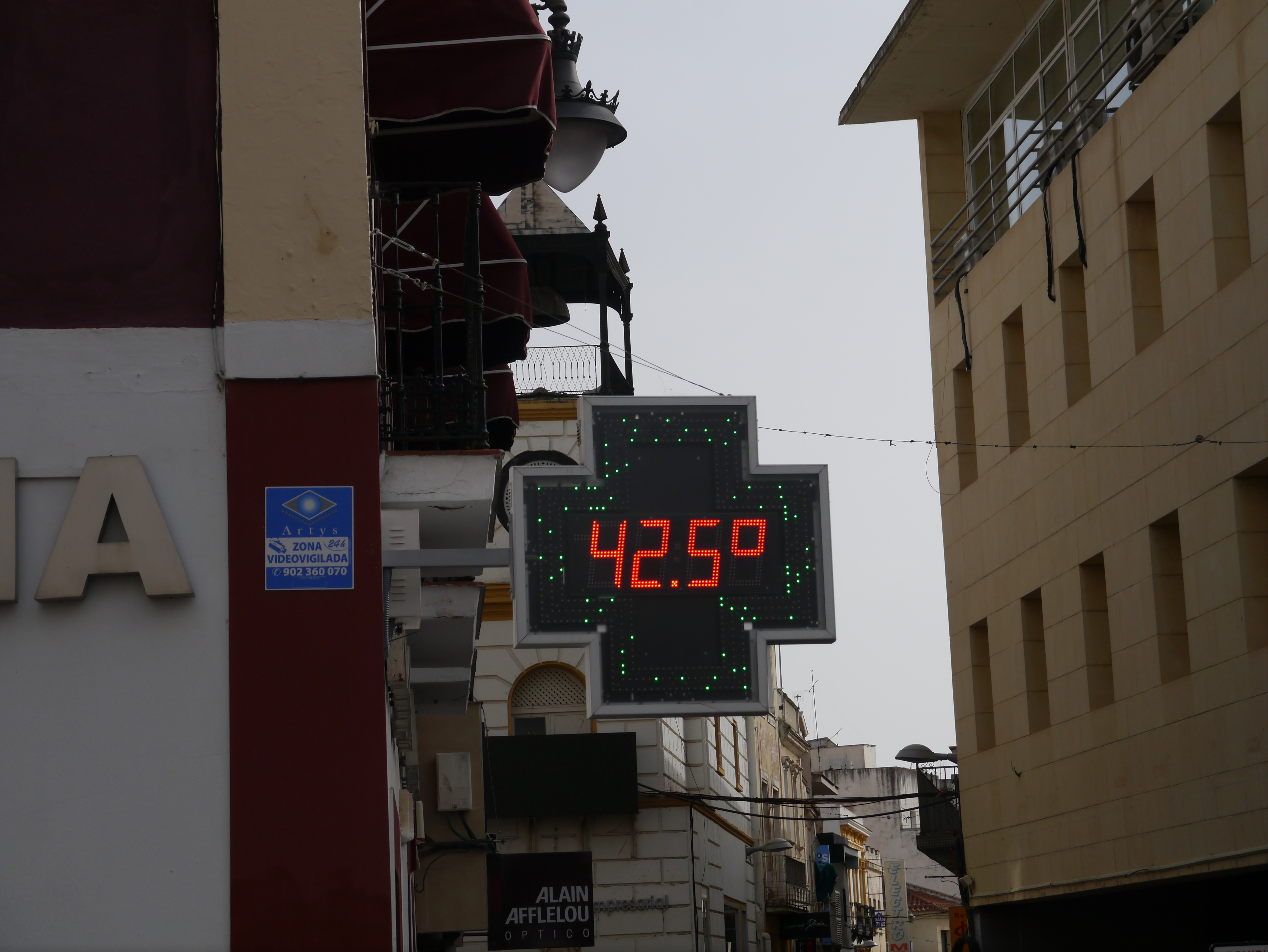
We had been advised to visit the extensive Roman ruins in Merida on our trip through central Spain. That was easier said than done……… we checked into our hotel around 3pm with temperatures nudging 45 degrees! (113 degrees Fahrenheit)! Needless to say we did what the locals do and took a short siesta to escape the heat.

It cooled down by 8PM

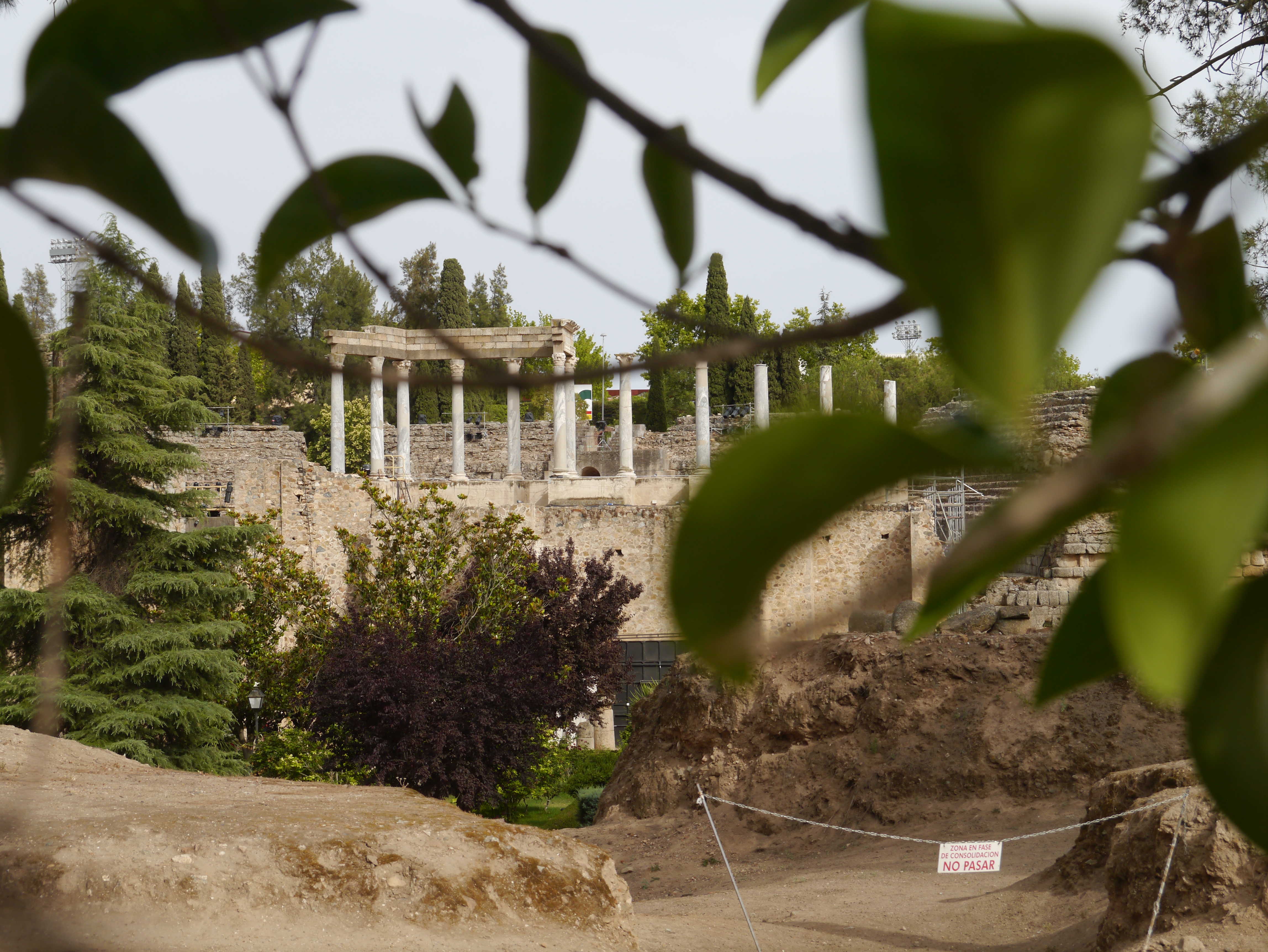
We ventured out around 6.30pm to visit the nearby ruins consisting of the Roman Circus, Roman Mithraeum House, Santa Eulalia Basilica and more. Our map led us straight there, right to the 7ft dense hedge that surrounded the ruins, no sneak peeks here! There has to be a entrance somewhere…….. we found the tourist office who gave us a little slip of paper with the visiting hours. Sunday 9.30 am – 9pm, Friday and Saturday 9.30am to 9pm… great! We were there on a Wednesday, not so good! Monday to Thursday 9.30am – 1.45pm & 5pm – 7.15pm………. it was now 7pm and we had to weigh the entry cost of €12 each or €6 as a EU citizen, for a visit that would be 15 minutes at the most!!

We settled for the brief glimpses we could catch through the hedge!!!!!

Peeking through the fence

The Theatre and Amphitheater are open 9.30am – 9pm every day; however they were on the other side of town, too far to walk in this heat. Good news is that the ticket covers entry to all of the ruins and includes a guide booklet.

I am sure they are worth a visit…….  arrive on a weekend and you will have all day to explore, along with the hordes. For midweek visits it is best to plan to stay over more than one night, as we had to be gone long before 9.30 am the next morning. Oh well next time!


0 comments

Earthquake creates Cheese!

At least that’s what happened in Roquefort-sur-Soulzon, over a million years ago, the ground, rattled and rolled, sinking down into a oval shaped valley, dominated by the still standing mountains which now housed what would be come to be known as the Combalou Caves.

The Roquefort Valley

Roquefort is the home of that gourmet delicacy, veined blue cheese……. Which people love or hate? We like it and decided that a visit to its birthplace was worthwhile. Only cheese that is matured in these ancient caves is allowed to be called Roquefort.

Legend has it that a young sheepherd, spied a beautiful maiden while enjoying his lunch of bread and cheese in the caves. He was so smitten he followed her abandoning his sheep and his lunch. When he returned weeks later both bread and cheese were covered in blue mold, luckily for us hunger prevailed and he liked the now “blue” cheese.

The cheese is made from sheep’s milk which are valley bred specifically for there milk, the milk is tested then mixed with a special bacteria Roqueforti penicillum which they reproduce themselves. This bacterium is what gives the cheese its distinctive flavour. The rennet is added, the curds, collected, drained and moulded.

Each round is pierced top to bottom in about 40 places; these holes allow the formation of those distinctive veins. The cheese rounds are rolled in salt and then placed on special salted racks in the caves to mature. During this time the internal heat of the cheese due to the fermentation process melts the exterior salt and it is absorbed into the cheese, helping impart that particular tangy taste.

The maturing length is different for each type of cheese and the whole process is carefully monitored by experienced masters, who carefully sample and check the cheeses during this period.

A whole lotta cheese

What we found really interesting is that unlike other cheese productions we have visited, where gleaming stainless steel surfaces are the norm. We saw vast dusty, dark, cobwebby caverns, containing row upon row of gleaming cheese moons, standing to attention on salt covered boards. The production and moulding process is no doubt carried out in stainless sterility; the maturing not so much.

Roquefort was praised by Pliny the Elder in 79 A.D. He and other Romans loved its flavor and paid high prices to import it. In the 700s, the emperor Charlemagne enjoyed Roquefort at his Christmas feasts. The first recorded mention of “Roquefort” was in 1070. It became so popular that Charles VI granted a monopoly on its manufacture to the people of Roquefort-sur-Soulzon in 1411. Apparently Casanova loved it as much as the fairer sex!

Obviously with such history it is no wonder that in 1925 it was the first cheese to receive the “Appellation d’Origine Controlee”.

It is definitely worth a visit, do remember to take a jacket though as the caves are a consistently cool 10 degrees centigrade, water seeps down and puddles in places. The whole cave system is ventilated by the “fleurines” which are natural cracks or apertures which link the caves with each other and the outside air. The air flow through these can be adjusted as needed, maintaining the constant temperature during the hottest summer and the coldest winter.

The tour was very informative although given in French; we had a English transcript to follow as we followed our guide through the dimly lit tunnels.

Best part of the tour has to be the samples….. and of course the chance to buy your favorite’s!

Tip; Store your cheese in the bottom of the fridge wrapped tightly in tin foil…… they wrap the whole cheeses in foil once the maturing process has finished as it puts the “cheese to rest”!

Bon appetit!


In the Roquefort Caves


0 comments

Two months already!

It seems impossible to say that we have now been on our “Escape” adventure for over two months! A busy two months indeed, we have visited England, France, Belgium, Luxemburg, Germany, Switzerland, Italy, Spain, Morocco, Gibraltar, Portugal & Andorra! A grand total of 11 countries, (Gibraltar is not technically a different country). We have also gone from wet, cold soggy days to temperatures in the mid 40’s, blistering sunshine and gentle ocean breezes………. All in all we are having a blast!

We have looked after 3 different properties with their furred, feathered friends, have been invited back to 2 of them, met a lot of wonderful people, ate a lot and yes drunk a lot! It has been wine country!

It seems impossible that only a few months ago we were in the throes of downsizing, throwing out, cleaning out and the emotional turmoil that went with it! I can honestly say that our preparation work has paid off. Apart from a slight hiccup with our first automatic credit card payment, our banking is running smooth and steady. Having a real person in branch who responds to emails is priceless!

We went paperless for as much as we could and our snail mail is slowing down to a trickle, having someone to handle that is a BIG help! Our property manager sends us a email every month with our statement, the rent is deposited monthly, bills are on automatic payment, the renters are taking good care of the property. As long as we have secure internet access we can access whatever is needed. It is a constant surprise as to how easy access and communication is compared to our first extended trip back in 1995………….  pre internet! Yikes!

Before we left and while getting ready to leave my biggest concern was having someone else live in our home, contrary to my imaginings I have not been plagued with fears of what is happening there; I have hardly given it a thought! This is probably a combination of being comfortable with the manager, the tenants and the fact that we left it empty, bare and clean. That crazy last few weeks was a very purging experience, both physically & emotionally!

We are still downsizing, our stuffed suitcases are slowly getting pared down…… by the time we get back to Canada at the end of our first leg we will be much better prepared for our next part of the world. This time we are going to travel light!

Michael & Yvonne Chilling in the Algarve

We have learnt a lot about ourselves & our relationship in the last two months. Away from the pressures of work and other commitments we are spending all our time together, which has its upside and downside, for instance both of us get a little cranky when hungry!!! This can lead to some interesting reactions and interactions, beauty of it is we have the time to stop what we are doing, discuss what is going on and then move on. The upside is that we have the time to enjoy the sunsets, stroll through cicada singing woods, stroll miles of beach, wander alpine meadows, enjoy people watching in these beautiful little towns and cook together. In case you haven’t noticed we are really enjoying the cooking and the eating.

We are now getting enough sleep, exercise and sunshine! Weather reports back home are not so sunny!

Life is definitely sunny, we have not lost a moments sleep worrying or regretting what we have done! The Ticos in Costa Rica say “Pura Vida” “The Good Life” which is exactly how we feel! Pura Vida!

0 comments

Gazpacho – Cool soup!

Gazpacho is a tomato-based, vegetable soup traditionally served cold,. This type of soup  originated in the Andalucía region of Spain.

I made some today after watching Jamie Oliver whip up a batch on TV.

Ingredients:

Stale Bread, Tomato, Cucumber, Green Bell Pepper, Sweet Onion (or Red Onion), Garlic, Olive Oil, and a little bit of Hot Chilli (optional)

Preparation:

  1. Wash and peel the vegetables
  2. Soak the stale bread (use fresh bread if no stale bread is around)
  3. Throw everything into a food processor or blender
  4. Add cold water (or ice cubes) to achieve  the desired consistency

Gazpacho is most thrilling chilled –   It is a fantastically  refreshing soup especially when the weather is hot.

Enjoy!!


0 comments

Sticks, water & tradition!

You may have heard of “jousting”……… men in full armour carrying a heavy lance hurtling towards each other as fast as their sturdy mounts will carry them. The winner being whoever managed to stay in the saddle the longest!

Sete, France an old Phoenician town intersected with canals (not quite Venice) has a very interesting sport! “Canal Jousting”  Replace the armour with fetching outfits of white pants, white shirt with blue and white striped shirt underneath, add white socks a white shield and a metal tipped jousting pole. The steed is a 10 oared boat, complete with steersmen, drummer, oboe player and the “knight” perched precariously on the very tip of the insectile elevated stern or “Jousting platform”.

The knight’s take position, raise their shield and lance and they are on……. 20 men rowing at full speed…… drummers, oboe players and the shore based brass band are off!!!!! Who is going to get knocked from their high perch? The Bleu knight or the Rouge, or maybe both!

This has been a summer event since the 1660’s, it incorporates chivalry, camaraderie & competition in all ages….. we missed the infant event, witnessed what appeared to be the under twenties event, which is to be followed by the “Big Boys” on Sunday!

The main events take place on the “Cadre royal quai de la resistance” or the Royal Canal…. You cannot miss it, as it has grandstands in place. These are free of charge, arrive early for the best seats or alternatively dine at one of the neighbouring restaurants as they have great ringside seating!

To me these young men are to be commended for their dedication and chivalry. Some charges are aborted (unlike in days of yore) safety is paramount…… In a sport that involves being hit hard, by a metal tipped pole, losing your footing and bouncing off your own platform or your enemies before hitting what must be cold water!

As the action commenced the stands filled rapidly, all eager to share in the successes? We were applauding the valiant efforts of the knights who maintained their footing. It was the demise of one or both knights who got the most applause though………. especially when it was one of those “ouch” moments. More than one bandaged finger and bruised arm was sported by these chivalrous young gentleman, not a gentle sport……. shield, pole, opponent and two platforms between them and hopefully a soft, if wet landing.

What a fun day! Thanks to a tip from our hosts…… the most fun times we have seem to be from following up from tips from those in the know!

Sete is also a great place for fresh mussels! Fresh, plump and tasty for less than back home! Jousting is a summer sport, check the schedule in advance and combine jousting, wine and mussels……. Life’s good!


0 comments
error: